Not every media problem is a DAM problem. A fair number of DAM programmes are launched because “we can’t find our images”, which is one symptom of about five different conditions, only two of which a DAM treats.
Short answer: there are four real alternatives. Object storage plus custom code, an image CDN, the media library in a system you already own, and API-first media infrastructure. The first is almost always more expensive than it looks. The second and third are correct in narrower situations than people assume. The fourth is a DAM in the ways that matter and not in the ways that cost, which is why it is the right answer for most organisations that reach this question.
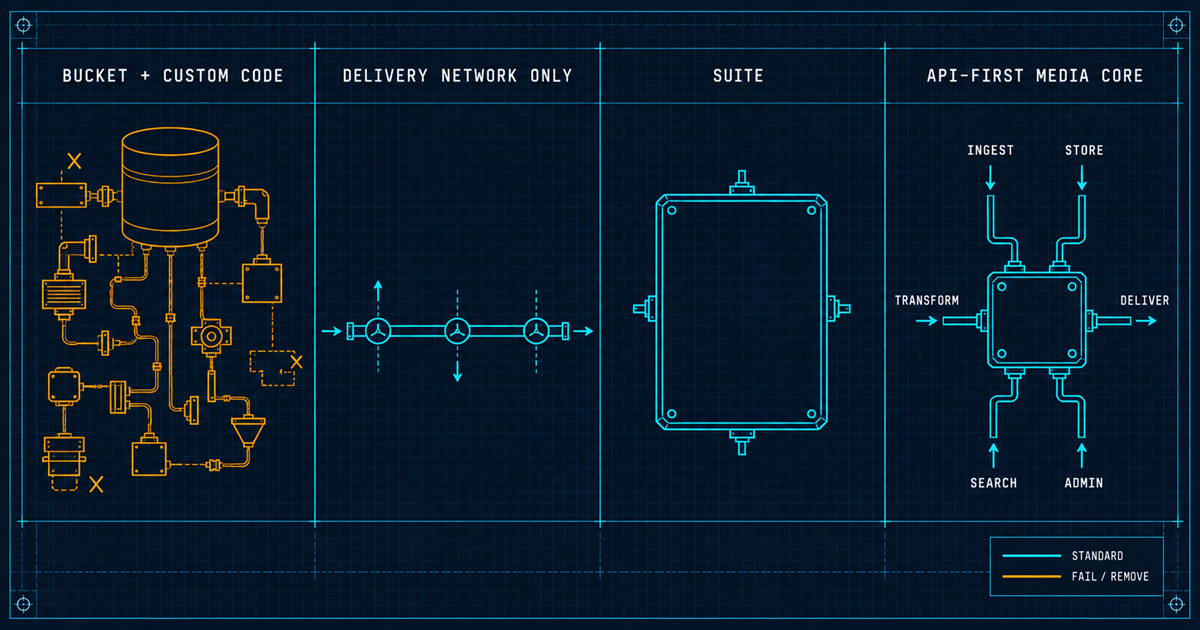
Alternative one: object storage plus custom code
Put everything in S3 or equivalent, keep metadata in a database, and write the rest.
The pitch. Storage costs almost nothing, you control everything, and it is three weeks of work.
What actually gets built. It is never three weeks, because the DAM was never the storage. It was everything around it. In order of discovery: an upload service with validation, a metadata schema and its admin interface, a search index because SQL LIKE over a description field is not search, a permission model, a resize and format conversion service, a cache and its invalidation, a versioning scheme, an audit log, and a user interface for the people who are not engineers.
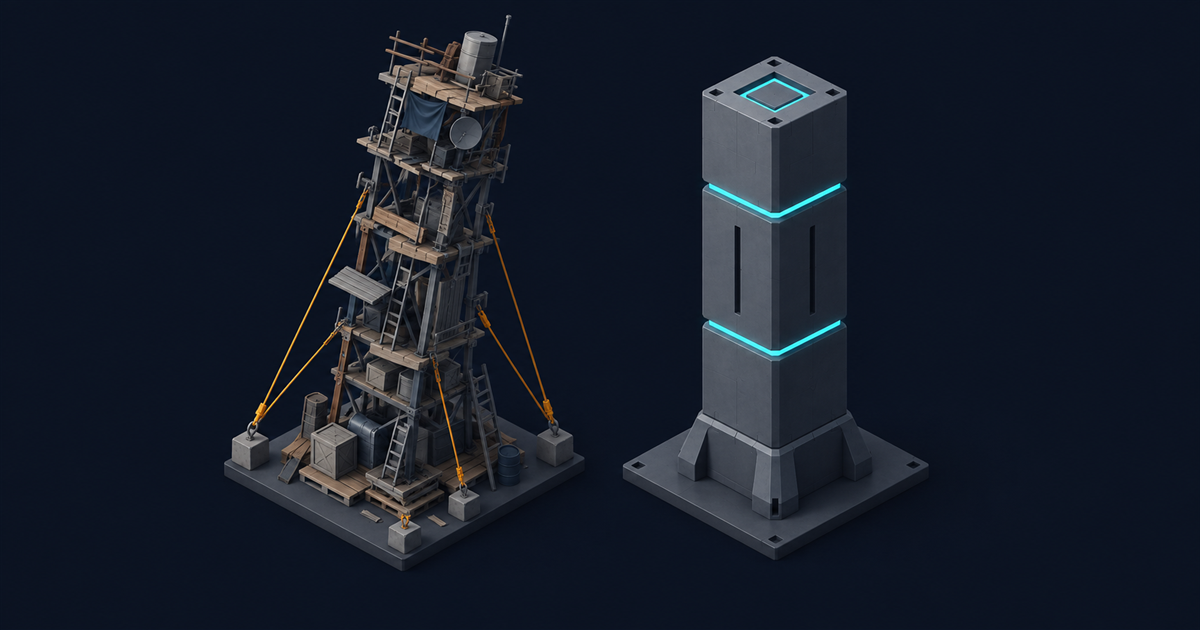
That is a two-year product with a permanent team. Organisations that go this way generally do not decide to build a DAM; they build one accidentally, one ticket at a time, and discover after eighteen months that they own a product with no roadmap and one person who understands it.
When it is genuinely right. When your media requirements are so specific that no product fits, and you have a platform team that will own it as a product with allocated capacity. That is a real situation. It is much rarer than the number of teams currently attempting it.
The honest tell. If the plan includes “we’ll add metadata later”, the project has already failed. Metadata is the product. Storage is the easy part, which is exactly the argument in why the shared drive stops working.
Alternative two: an image CDN
Keep the originals wherever they are and put a transforming delivery layer in front. imgix, ImageKit and Cloudflare Images all do this well.
What you get. Resize, format conversion, quality optimisation, edge caching. Real, immediate performance and bandwidth improvements, often within a day.
What you do not get. Any management layer. No metadata, no rights, no approval state, no lifecycle, no audit trail, no interface for non-technical users. It is a delivery layer, and it is honest about being one.
When it is right. When your problem is genuinely delivery and your assets are already managed adequately elsewhere, or when there are few enough of them that management is not the issue. A product marketing site with two hundred images and one owner does not need a DAM. It needs faster images.
The trap. Adding it alongside a DAM that cannot deliver. Now you have two systems and a propagation problem: a licence expiring in the DAM has to reach the image CDN, and that propagation is yours to build, test and maintain. That seam is where takedowns fail, and it is the argument in single source of truth is an architecture.
Alternative three: the media library you already own
Your CMS has one. So does your commerce platform, your marketing automation tool and your intranet.
When it works. One system consumes the assets, one team maintains them, and there is no external distribution. Then the CMS media library is the correct answer and adding a DAM adds an integration without adding a capability.
When it stops working. The moment a second system needs the same assets. Now one of them is authoritative and the other holds copies, or worse, both hold copies and neither is authoritative. That is the divergence problem the whole category exists to prevent, and it arrives quietly.
The honest threshold. Not asset count. The number of independent systems and teams that need the same material. One of each, stay where you are. Two or more, you have a system-of-record question, and it is worth reading who owns which record before you answer it.
Alternative four: API-first media infrastructure
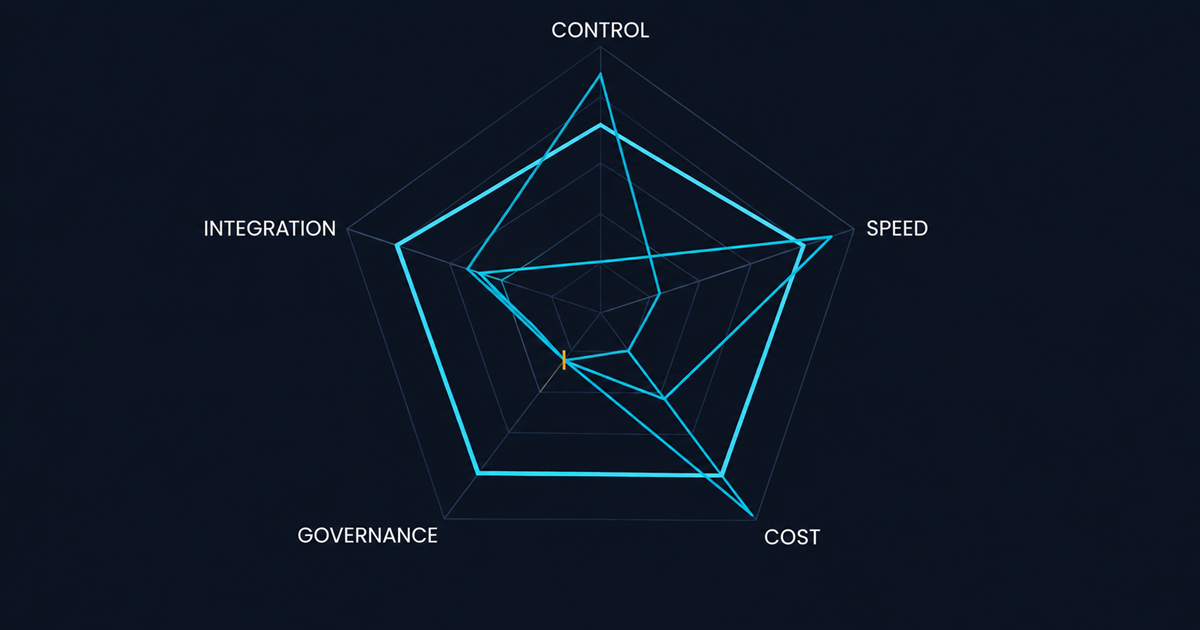
One platform that holds the master, carries its metadata and rights, and delivers derivatives on request. Management and delivery in the same system rather than two systems with a seam between them.
This is what most organisations asking the alternatives question are actually looking for, and it is worth being precise about why rather than just asserting it.
It removes the build. You get the upload service, schema, search, permissions, versioning, transformation, caching and audit log as product rather than as a backlog. That is the whole of alternative one, already written and maintained by someone else.
It removes the seam. Because the library and the delivery layer share one asset store, there is no propagation to build. Expiry, replacement and takedown are one operation on one object. That is the failure mode of running alternatives two and three together, and it does not arise here.
It keeps the management layer. Unlike an image CDN, there is a metadata model, a rights model and an interface for people who are not engineers. Cloudinary’s structured metadata is typed and validated at the API rather than only in the upload form, which is what keeps data quality intact when assets arrive through integrations rather than through a person.
It scales down as well as up. Published pricing starting at a free tier of 25 credits per month, with Plus at 99 dollars per month for 225 credits and Advanced at 249 for 600, means you can build against the real platform before anyone signs anything. A credit covers 1,000 transformations or 1 GB of storage or 1 GB of delivery. In a category where most vendors gate the number behind a sales process, being able to model and prototype first changes how the decision gets made.
It is addressable by whatever comes next. SDKs across roughly seventeen languages and a machine-readable onboarding and MCP layer mean the next consuming system, whoever writes it and however it is written, does not need a project to connect. The solution overview is the shortest description of how the pieces fit.
The trade-off, stated plainly: if your dominant use case is hundreds of non-technical people browsing and downloading all day, a brand library product has a nicer interface for that specific job. That comparison is made properly in the platform comparison, and it is a real consideration rather than a formality.
How to tell which one you need
Four questions. They resolve it in about ten minutes.
1. How many systems consume these assets? One means the media library you already own is probably fine. Two or more means you need a system of record.
2. Does anything in the library have an expiry date or third-party rights? If yes, you need a management layer, which rules out the image CDN on its own. The exposure is described in rights and expiry as first-class asset data.
3. Do assets need to reach browsers at the right size and format? If yes, delivery is in scope, and the reasons are in delivery is part of your DAM.
4. Do you have a platform team with capacity to own an internal product for five years? If no, alternative one is not available to you, whatever the initial estimate says.
Most organisations answer two or more, yes, yes, no. That combination points at alternative four, and it is why the API-first archetype has become the default rather than the specialist choice.
The one thing not to do
Do not run a DAM and an image CDN and a CMS media library at the same time with no decision about which is authoritative. That is the most common state of affairs in a mid-size enterprise, and it is worse than any of the four alternatives chosen deliberately, because it has the cost of all three and the guarantees of none.
If that describes you, the useful first step is not a procurement exercise. It is drawing the ownership map from who owns which record, which usually reveals that you already own most of what you need and have never said which copy wins. Then work out what moving to one authoritative store would take, using migrating a million assets, and check the result against the requirements checklist before anyone books a demo. The grounding for all of it is in what enterprise DAM actually is.