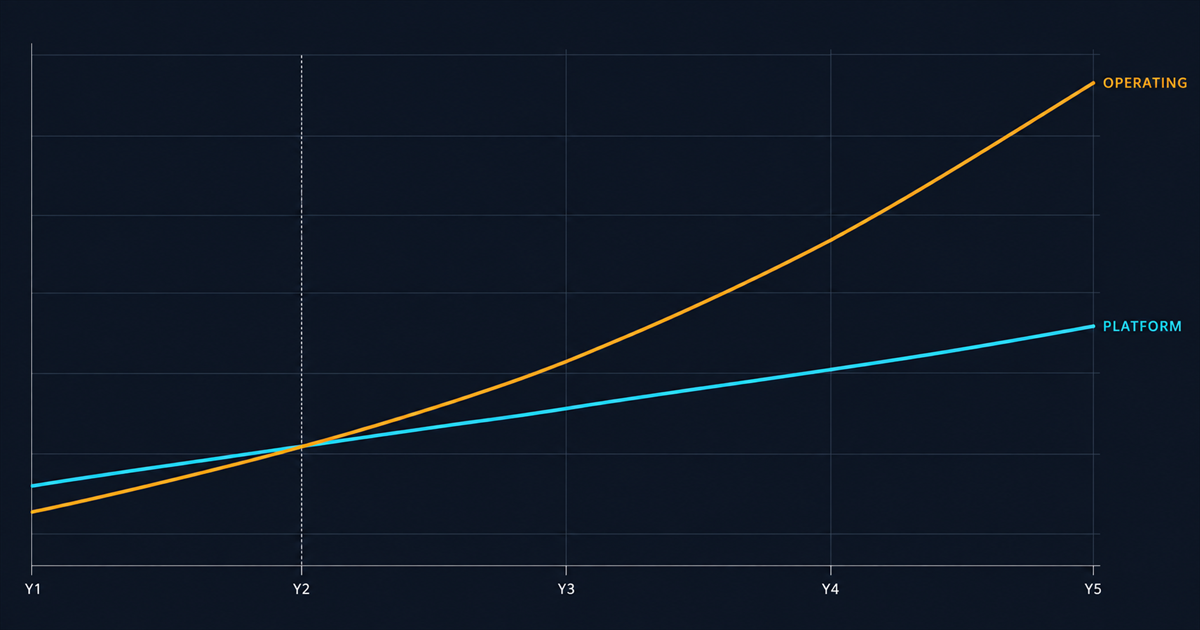
A vendor quotes 180,000 a year. Finance approves it. Two years later the programme has cost roughly double that and nobody can point at the moment it went wrong, because nothing went wrong. The quote was accurate. It was just answering a narrower question than anyone thought.
Short answer: budget the licence at somewhere between forty and sixty percent of your actual five-year cost. The rest is integration, migration, storage and delivery overage, and the people who run it. The people line is usually the largest single item and it is almost never in the business case, which is why so many DAM programmes are technically successful and commercially disappointing.
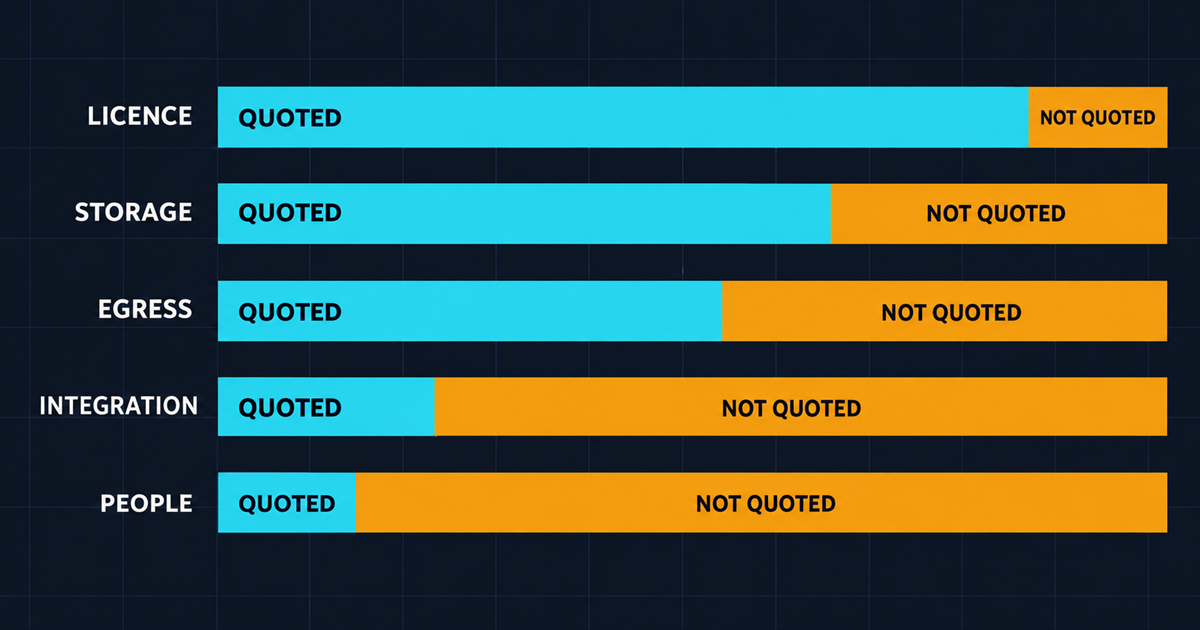
The full cost stack
Six lines. Build the model with all of them or you are not comparing vendors, you are comparing quotes.
1. Platform licence. The number on the proposal. Usually banded by seats, storage, or some composite. Ask specifically what happens on renewal, because year-one discounting is standard and the uplift in year two is where the real price lives.
2. Implementation and integration. Configuration, schema build, permission model, and connecting the DAM to everything that consumes from it. Vendors will quote the first three and not the fourth, because the fourth depends on your estate. In practice this runs from thirty to a hundred percent of first-year licence, and the variable is how many systems and how good their APIs are. Integration patterns is where that number actually gets set.
3. Migration. Moving and describing the existing library. Cost scales with how bad your current metadata is, not with how many terabytes you have. Ten terabytes of well-described material is a cheap migration. Two terabytes of IMG_4471_final_v3.jpg is not, and the reasons are in migrating a million assets.
4. Storage. Usually straightforward and usually small. The trap is not the rate, it is the multiplier. If your platform stores every rendition as a separate file, you are paying for the master plus every crop, every format and every size, forever. A derived-rendition model stores the master only.
5. Delivery and bandwidth. The line most often underestimated, because nobody models it until they are live. If your DAM also serves your public web traffic, this is a real number that scales with your marketing success. If it does not serve public traffic, you are paying for a separate CDN somewhere else and should count that here too.
6. People. A DAM manager or information governance lead, plus a share of a developer, plus the taxonomy and cataloguing time that has to come from somewhere. At mid enterprise scale this is typically 0.5 to 1.5 full-time equivalents on an ongoing basis. Fully loaded, that frequently exceeds the licence.
The three commercial models
Vendors price on one of three bases and they are not equivalent. Which one suits you depends almost entirely on your shape.
Per seat. Predictable, easy to approve, and it prices the thing you least want to restrict. Every seat you do not buy is a person who emails a colleague for the file instead, which is exactly the behaviour you are paying to eliminate. Watch for the distinction between full users and consumer or read-only users, because the ratio is usually ten to one and the pricing difference is where the negotiation lives.
Per volume. Storage, bandwidth, transformations, API calls, or a composite unit. Scales with usage rather than headcount, which means adoption success shows up as a cost increase. That is not a reason to avoid it, but it does mean you need a forecast and a monitoring habit, not just a budget line.
Enterprise agreement. Custom, negotiated, usually unbanded. Fine, and often the right answer at scale, but it removes your ability to benchmark. Get at least one banded quote from a comparable vendor so you know what you are being asked to pay a premium for.
Cloudinary is a useful reference point on the volume model because its pricing is published rather than gated, which is unusual in this category. The published tiers run from a free plan at 25 credits per month, through Plus at 99 dollars per month for 225 credits, to Advanced at 249 dollars per month for 600 credits, with enterprise agreements custom. The credit is a composite unit, and the definition is worth reading before you model anything: one credit covers 1,000 transformations, or 1 GB of managed storage, or 1 GB of delivered bandwidth, and you spend across those as you use them.
That composite structure is the part to model carefully. It is genuinely flexible, and it means your bill responds to the mix of what you do rather than to a single dimension. It also means a rough forecast needs three inputs rather than one.
Two details that materially change the arithmetic: transformations and bandwidth are measured over a rolling thirty-day window while storage reflects your current total, and re-delivery of an already-generated derivative does not count as a new transformation. The second one matters a lot. It means a heavily-cached public site costs far less in transformation terms than a naive calculation suggests.
Which lines do vendors leave out?
Reliably four, and none of it is dishonest. They are quoting their product, and these are your costs.
- Your integration effort. They quote their connector. They do not quote the six weeks your team spends on the other side of it.
- Delivery at production volume. Pilot traffic is not production traffic. Ask for the overage rate in writing, not just the included allowance.
- Ongoing cataloguing. Somebody describes the assets. That somebody costs money whether they sit in your team or an agency.
- The second-year uplift. Ask for a capped renewal in the contract. This single clause is worth more than most of the feature negotiation.

Where the money actually goes wrong
Not in the negotiation. In three specific decisions made after signature.
Storing renditions instead of deriving them. Every stored variant is storage you pay for, a sync problem you own, and a migration item later. If the platform can produce a crop from a URL parameter, use that, and the Cloudinary resizing documentation shows the shape of it. This is the difference between a storage line that grows with your library and one that grows with your library times fifteen.
Buying seats for people who only download. Most vendors have a cheaper consumer tier or a public collection mechanism. Full seats for the reseller network is the most common single overspend in this category.
Serving originals. If you deliver the master file to a web page because nobody set up automatic format and quality, you pay for the bandwidth twice: once at the DAM and once in your conversion rate. Automatic format and quality selection is a one-parameter change with a large bandwidth effect, and it is covered from the performance side in delivery is part of your DAM.
How do you build a number you can defend?
Do it in this order. It takes about a week and it survives contact with finance.
- Count the estate. Masters, renditions, annual growth, and current storage. Not folder size, actual distinct masters. The ratio between the two is itself a finding.
- Forecast delivery. Monthly image requests across all channels, plus average delivered size. If you do not have this, your CDN or web analytics does.
- List the integrations. Every system that will read from or write to the DAM, with a rough effort estimate each. This is the line that moves most between vendors.
- Staff it honestly. Name the roles and the fractions. If nobody is named, the programme has no owner and the adoption risk is your largest unpriced exposure.
- Model five years, not one. Total cost of ownership over the realistic life of the decision. Year one flatters the incumbent option and every platform looks cheap in a pilot.
Then take that model into the business case, where the benefit side gets the same treatment. And when you are comparing the resulting numbers between vendors, the platform comparison is organised by who each one is actually for, which is more useful than a feature grid once the prices are within twenty percent of each other.
If you are building the requirement list that generates these quotes in the first place, start from the requirements checklist and cut it before you send it. Every requirement you cannot justify is a line item somebody will price. The foundation for all of it is in what enterprise DAM actually is.
Leave a Reply