The DAM goes live and works. Six months later there are eleven integrations, four of them written by a contractor who has left, two of them polling every sixty seconds for changes that happen twice a week, and one that nobody can turn off because they are not sure what breaks.
That is not a technology failure. It is what happens when eleven integrations get built as eleven decisions instead of as instances of four patterns.
Short answer: almost every DAM integration is one of four patterns. Reference by URL, event-driven push, scheduled synchronisation, or embedded picker. Pick deliberately, because the wrong choice is not wrong on day one, it is wrong in month nine when the volume changes. The default should be reference by URL, and everything else needs a reason.
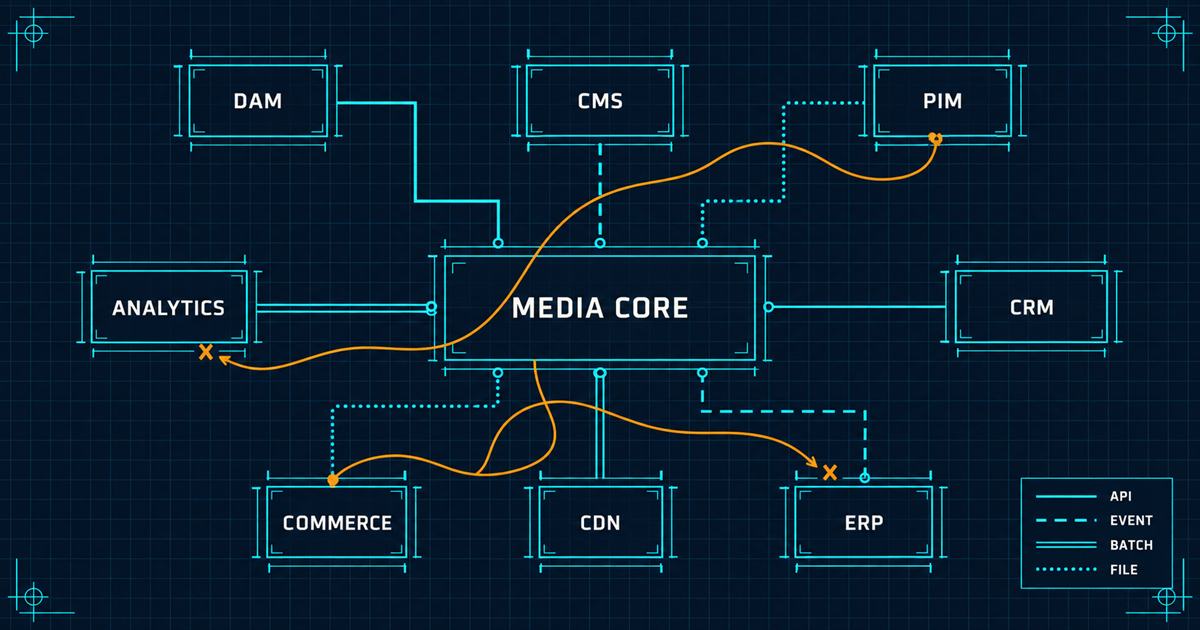
Pattern one: reference by URL
The consuming system stores a URL, not a file. When a page renders, the browser fetches the asset directly from the media platform, with the required transformation expressed in the URL itself.
Use it for anything rendered to an end user. Websites, applications, emails, partner pages, product feeds. This should be your default and it covers more ground than people expect.
Why it wins. There is one copy of the asset, and it lives in the system of record. Update the master and every surface updates. Add a new size and it is a string change. Nothing to sync, nothing to invalidate, no storage duplicated across five systems.
The prerequisite is that the platform can produce derivatives from the URL. If it cannot, this pattern degrades into “reference the original and let the browser download 4MB”, which is worse than the alternatives. Cloudinary’s URL delivery model is the reference for what to look for: the transformation is part of the address, the result is cached at the edge, and the origin is untouched.
How it fails. Two ways. Someone hardcodes a transformation string across the codebase and it becomes unchangeable, which is solved by named presets or a small helper. And the delivery domain becomes a hard dependency on your critical rendering path, which is a real availability consideration and belongs in your architecture review.
Pattern two: event-driven push
The DAM emits an event on a state change and the consuming system reacts. Asset approved, so publish it. Licence expired, so unpublish it. Asset replaced, so purge the cache.
Use it for anything where a state change must cause an action within minutes, and for keeping downstream indexes current.
Why it matters for governance. This is the mechanism that turns policy into behaviour. An expiry date in a field is a report. An expiry date that fires an event is a control, which is the distinction drawn in the governance framework. Cloudinary’s notification system covers upload, moderation and transformation events, which is the typical set.
How it fails. Reliably, and always the same way: nobody handles redelivery. Webhooks arrive more than once, arrive out of order, and occasionally do not arrive. Your handler must be idempotent, must verify the signature, and must have a reconciliation job behind it that catches what was missed. Teams that skip the reconciliation job discover the gap during an incident, which is an expensive way to learn it.
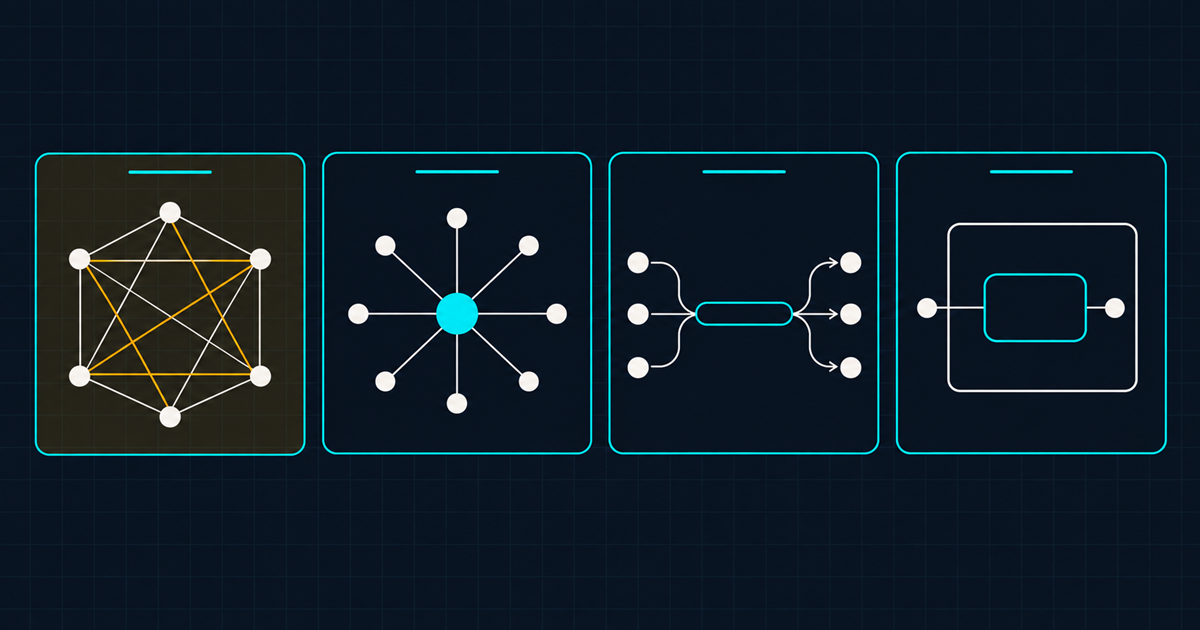
Pattern three: scheduled synchronisation
A job runs on a schedule, pulls changed assets or metadata, and updates the target system.
Use it for systems that genuinely cannot accept a reference or an event. Print production, legacy ERP, offline distribution, partner drops, and anything behind a boundary that will not allow inbound calls.
Why it is the last resort. It creates a second copy, which creates a divergence window, which creates the question “which one is right” that the DAM existed to eliminate. It is also the pattern most likely to still be running in five years after everyone forgot why.
How to make it survivable. Sync on a cursor rather than a full sweep, so cost scales with change rather than with library size. Record what was synced and when. Make it restartable. And give it an owner, because an unowned scheduled job is a future incident with a date on it.
How it fails. Full-table syncs that took four minutes at launch and take six hours at year three, running into the next window and overlapping with themselves.
Pattern four: embedded picker
The DAM’s asset selection interface is embedded directly in the consuming application, so an author picks an asset without leaving the CMS, the commerce admin or the campaign tool.
Use it for any human-facing authoring workflow. This is the single highest-leverage adoption intervention available to you, and it is consistently underrated in architecture reviews because it looks like a UI concern.
Why it matters. People use the path of least resistance. If choosing an approved asset requires opening a second system, searching, downloading, and uploading, a meaningful fraction of your authors will use the file on their desktop instead. Embedding removes four steps and, with them, most of the shadow library. Media library widgets are the standard mechanism.
How it fails. Authentication. The picker needs to know who the user is without a second login, which means the embedding application has to pass identity properly. Get this wrong and you have built a beautiful component that everybody dismisses because it asks them to log in again.
Point to point versus a hub
At three integrations, direct connections are fine. At eleven, they are a maintenance liability, because every consuming system has its own understanding of your schema and every schema change is eleven coordinated deployments.
The usual correction is a thin integration layer that owns the mapping, so schema changes land in one place. Two cautions from having watched this go wrong:
Do not put the hub on the read path. Rendering should go direct to the delivery URL. A hub in front of image delivery is a bottleneck and an availability risk for no benefit.
Do not let the hub accumulate business logic. It should map and route. The moment it starts deciding which crop a channel gets, you have a second system of record and you are back where you started.
How do you keep integrations from rotting?
Four practices. None are clever and all are skipped.
- A register. Every integration listed with its pattern, owner, credential, and what breaks if it stops. This document takes an afternoon and it is the difference between a controlled estate and archaeology.
- Service accounts, not personal ones. An integration running under a departed employee’s credential is an outage scheduled for the day IT does its access review. This is also an audit finding, covered in access control, SSO and audit trails.
- Server-side signing. Any write path from a browser gets signed requests generated server-side. Keys never reach a client. There is no acceptable exception to this.
- Cache headers you chose. Long max-age on immutable derivative URLs, with a version token so a replaced master produces a new URL rather than requiring a purge. The HTTP caching guide covers the mechanics, and getting this right is most of the win described in delivery is part of your DAM.
The decision, compressed
Ask two questions per integration and the pattern falls out.
Does a human select the asset? If yes, embedded picker for the selection and reference by URL for the rendering. If no, continue.
Does the consuming system need the bytes, or just the address? If the address, reference by URL. If the bytes, event-driven push where the system can receive calls, scheduled sync where it cannot.
That is genuinely the whole decision tree. The complexity in most estates comes from making this choice implicitly, once per project, under delivery pressure, rather than deciding it once as an architecture standard.
Before you build any of it, settle which system owns which field, because an integration that moves a field between two systems that both allow editing is not an integration, it is a future data quality incident. That map is in who owns which record, the API surface these patterns depend on is in headless DAM, and the architectural principle underneath all of it is in single source of truth is an architecture. For the wider context, what enterprise DAM actually is.
Leave a Reply