Tag: Integration

Connecting the DAM to the systems that consume from it: reference by URL, event-driven push, scheduled synchronisation and embedded pickers.

  • Integration patterns for an enterprise DAM

    Integration patterns for an enterprise DAM

    The DAM goes live and works. Six months later there are eleven integrations, four of them written by a contractor who has left, two of them polling every sixty seconds for changes that happen twice a week, and one that nobody can turn off because they are not sure what breaks.

    That is not a technology failure. It is what happens when eleven integrations get built as eleven decisions instead of as instances of four patterns.

    Short answer: almost every DAM integration is one of four patterns. Reference by URL, event-driven push, scheduled synchronisation, or embedded picker. Pick deliberately, because the wrong choice is not wrong on day one, it is wrong in month nine when the volume changes. The default should be reference by URL, and everything else needs a reason.
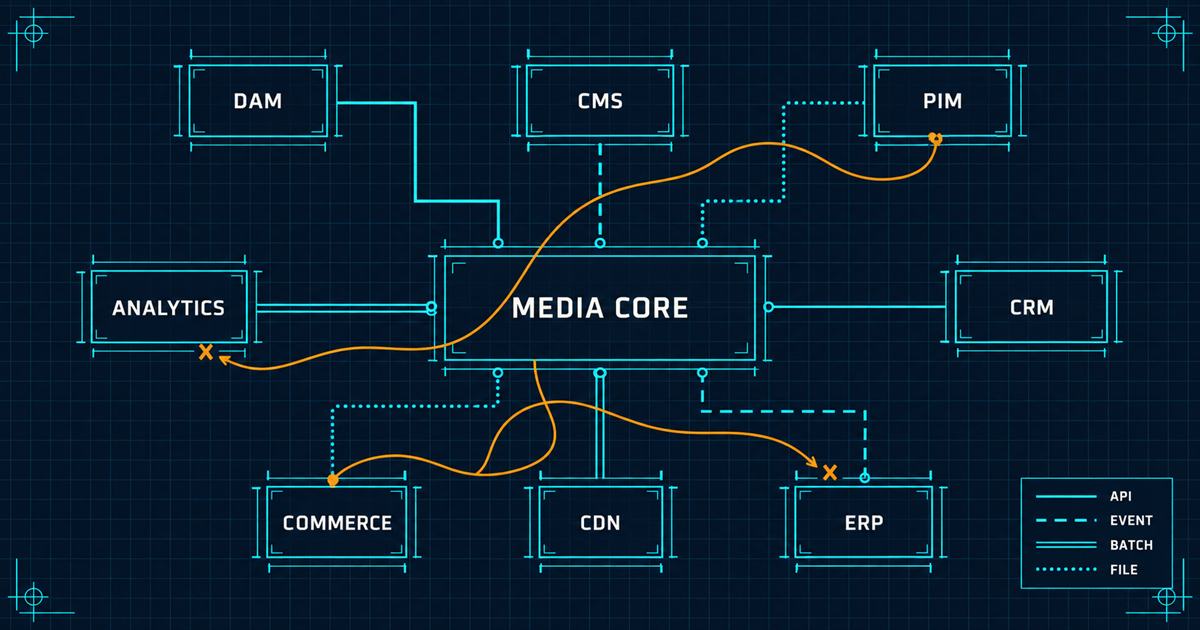
    A large orthographic schematic of a central media core with eight labelled satellite systems, four line treatments for four integration patterns, and two amber point-to-point connections crossing untidily

    Pattern one: reference by URL

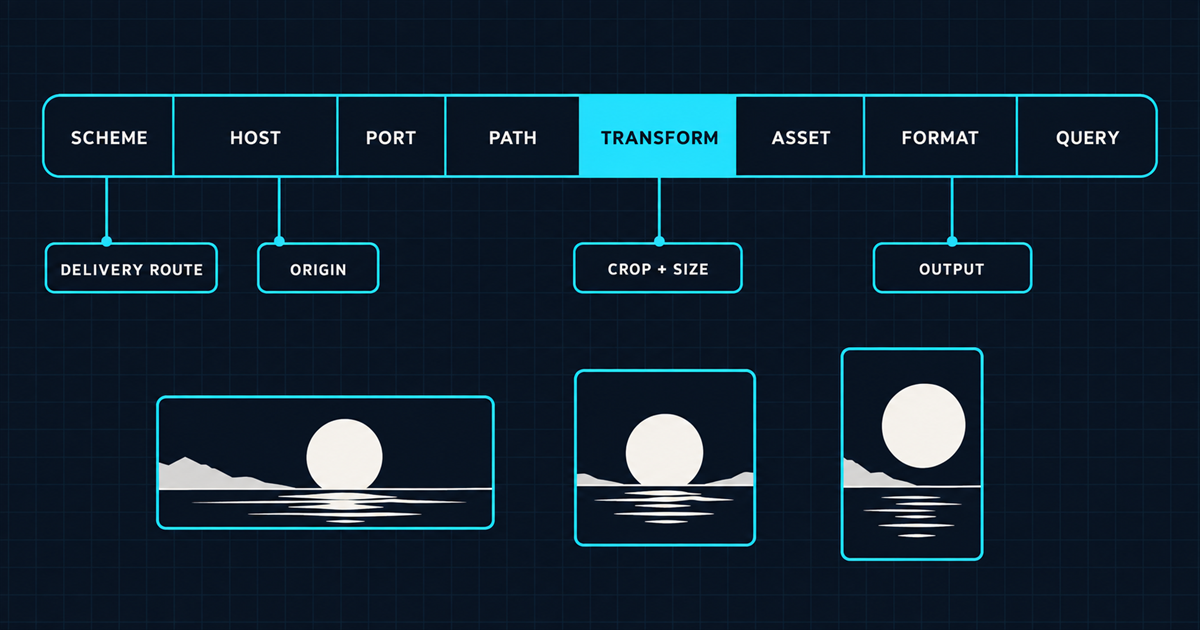
    The consuming system stores a URL, not a file. When a page renders, the browser fetches the asset directly from the media platform, with the required transformation expressed in the URL itself.

    Use it for anything rendered to an end user. Websites, applications, emails, partner pages, product feeds. This should be your default and it covers more ground than people expect.

    Why it wins. There is one copy of the asset, and it lives in the system of record. Update the master and every surface updates. Add a new size and it is a string change. Nothing to sync, nothing to invalidate, no storage duplicated across five systems.

    The prerequisite is that the platform can produce derivatives from the URL. If it cannot, this pattern degrades into “reference the original and let the browser download 4MB”, which is worse than the alternatives. Cloudinary’s URL delivery model is the reference for what to look for: the transformation is part of the address, the result is cached at the edge, and the origin is untouched.

    How it fails. Two ways. Someone hardcodes a transformation string across the codebase and it becomes unchangeable, which is solved by named presets or a small helper. And the delivery domain becomes a hard dependency on your critical rendering path, which is a real availability consideration and belongs in your architecture review.

    Pattern two: event-driven push

    The DAM emits an event on a state change and the consuming system reacts. Asset approved, so publish it. Licence expired, so unpublish it. Asset replaced, so purge the cache.

    Use it for anything where a state change must cause an action within minutes, and for keeping downstream indexes current.

    Why it matters for governance. This is the mechanism that turns policy into behaviour. An expiry date in a field is a report. An expiry date that fires an event is a control, which is the distinction drawn in the governance framework. Cloudinary’s notification system covers upload, moderation and transformation events, which is the typical set.

    How it fails. Reliably, and always the same way: nobody handles redelivery. Webhooks arrive more than once, arrive out of order, and occasionally do not arrive. Your handler must be idempotent, must verify the signature, and must have a reconciliation job behind it that catches what was missed. Teams that skip the reconciliation job discover the gap during an incident, which is an expensive way to learn it.
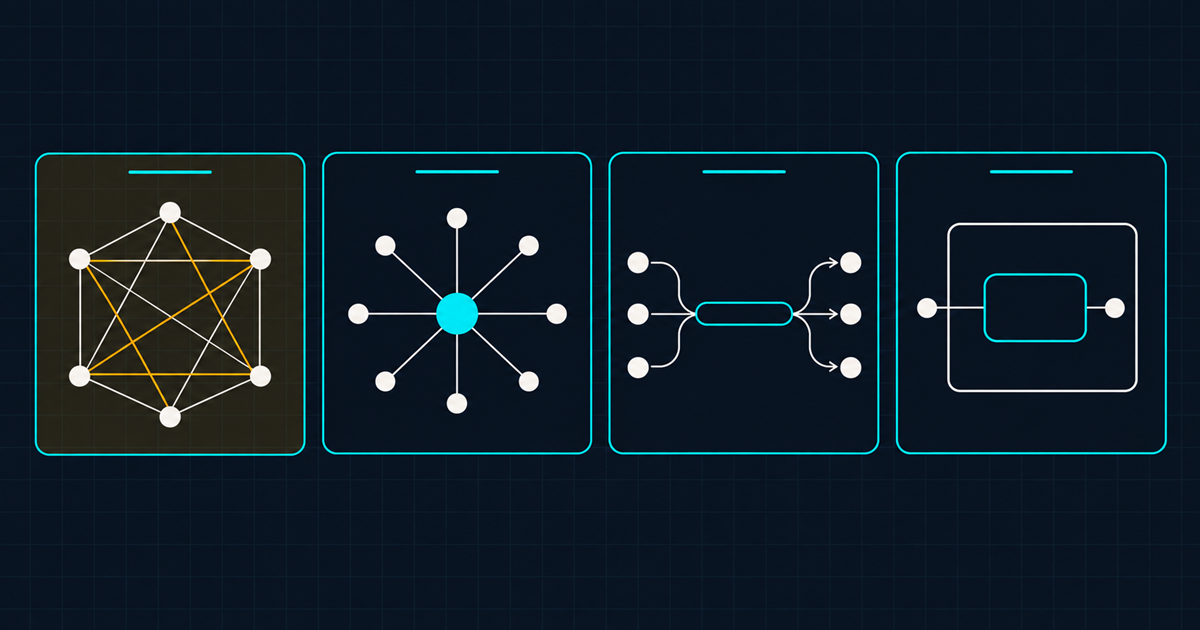
    Four small pattern cards in a row showing point-to-point, hub and spoke, event driven and embedded widget topologies, the point-to-point card visibly tangled and tinted amber

    Pattern three: scheduled synchronisation

    A job runs on a schedule, pulls changed assets or metadata, and updates the target system.

    Use it for systems that genuinely cannot accept a reference or an event. Print production, legacy ERP, offline distribution, partner drops, and anything behind a boundary that will not allow inbound calls.

    Why it is the last resort. It creates a second copy, which creates a divergence window, which creates the question “which one is right” that the DAM existed to eliminate. It is also the pattern most likely to still be running in five years after everyone forgot why.

    How to make it survivable. Sync on a cursor rather than a full sweep, so cost scales with change rather than with library size. Record what was synced and when. Make it restartable. And give it an owner, because an unowned scheduled job is a future incident with a date on it.

    How it fails. Full-table syncs that took four minutes at launch and take six hours at year three, running into the next window and overlapping with themselves.

    Pattern four: embedded picker

    The DAM’s asset selection interface is embedded directly in the consuming application, so an author picks an asset without leaving the CMS, the commerce admin or the campaign tool.

    Use it for any human-facing authoring workflow. This is the single highest-leverage adoption intervention available to you, and it is consistently underrated in architecture reviews because it looks like a UI concern.

    Why it matters. People use the path of least resistance. If choosing an approved asset requires opening a second system, searching, downloading, and uploading, a meaningful fraction of your authors will use the file on their desktop instead. Embedding removes four steps and, with them, most of the shadow library. Media library widgets are the standard mechanism.

    How it fails. Authentication. The picker needs to know who the user is without a second login, which means the embedding application has to pass identity properly. Get this wrong and you have built a beautiful component that everybody dismisses because it asks them to log in again.
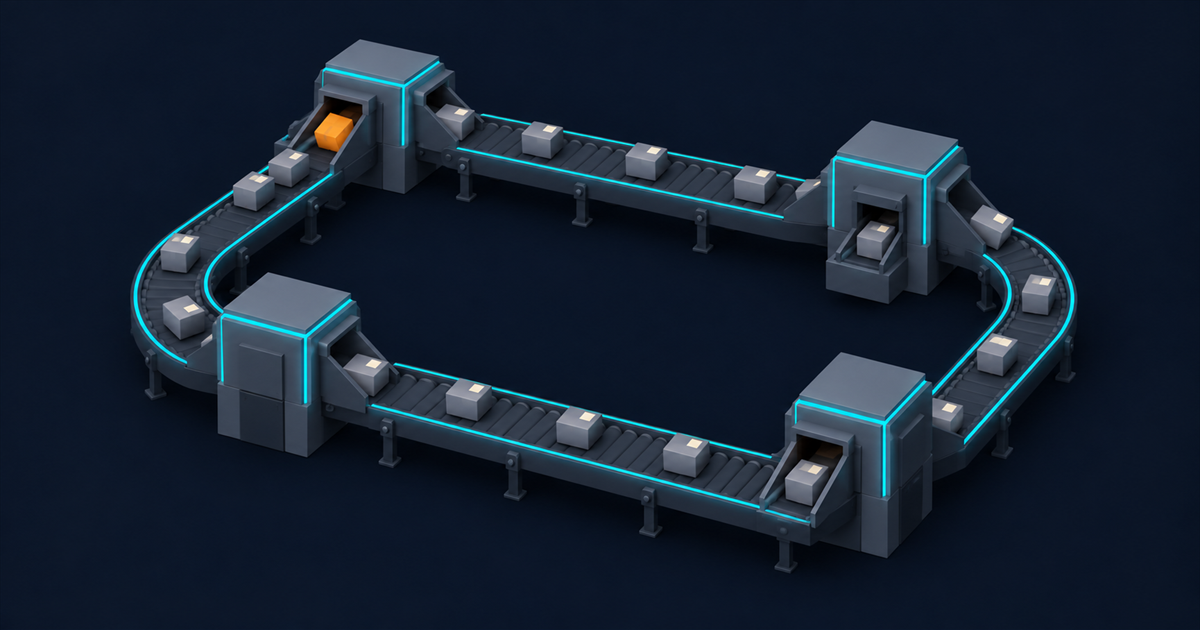
    An isometric conveyor loop carrying tagged parcels between four station blocks, with one station jammed amber and parcels backed up behind it

    Point to point versus a hub

    At three integrations, direct connections are fine. At eleven, they are a maintenance liability, because every consuming system has its own understanding of your schema and every schema change is eleven coordinated deployments.

    The usual correction is a thin integration layer that owns the mapping, so schema changes land in one place. Two cautions from having watched this go wrong:

    Do not put the hub on the read path. Rendering should go direct to the delivery URL. A hub in front of image delivery is a bottleneck and an availability risk for no benefit.

    Do not let the hub accumulate business logic. It should map and route. The moment it starts deciding which crop a channel gets, you have a second system of record and you are back where you started.

    How do you keep integrations from rotting?

    Four practices. None are clever and all are skipped.

    • A register. Every integration listed with its pattern, owner, credential, and what breaks if it stops. This document takes an afternoon and it is the difference between a controlled estate and archaeology.
    • Service accounts, not personal ones. An integration running under a departed employee’s credential is an outage scheduled for the day IT does its access review. This is also an audit finding, covered in access control, SSO and audit trails.
    • Server-side signing. Any write path from a browser gets signed requests generated server-side. Keys never reach a client. There is no acceptable exception to this.
    • Cache headers you chose. Long max-age on immutable derivative URLs, with a version token so a replaced master produces a new URL rather than requiring a purge. The HTTP caching guide covers the mechanics, and getting this right is most of the win described in delivery is part of your DAM.

    The decision, compressed

    Ask two questions per integration and the pattern falls out.

    Does a human select the asset? If yes, embedded picker for the selection and reference by URL for the rendering. If no, continue.

    Does the consuming system need the bytes, or just the address? If the address, reference by URL. If the bytes, event-driven push where the system can receive calls, scheduled sync where it cannot.

    That is genuinely the whole decision tree. The complexity in most estates comes from making this choice implicitly, once per project, under delivery pressure, rather than deciding it once as an architecture standard.

    Before you build any of it, settle which system owns which field, because an integration that moves a field between two systems that both allow editing is not an integration, it is a future data quality incident. That map is in who owns which record, the API surface these patterns depend on is in headless DAM, and the architectural principle underneath all of it is in single source of truth is an architecture. For the wider context, what enterprise DAM actually is.

  • Headless DAM: when the API is the product

    Headless DAM: when the API is the product

    Every DAM vendor has an API now. That sentence is true and almost entirely uninformative, because it covers both a system designed API-first and a system where someone exposed nine endpoints in 2021 to close a deal.

    The distinction is not marketing. It determines whether your integration project takes six weeks or six months, and whether the platform can serve channels that do not exist yet.

    Short answer: headless DAM means the API is the product and the web interface is one client of it, with no privileged access. The test is simple. Anything a user can do in the interface, you can do over the API, with the same permissions model and the same validation. If there is a gap, the API is a reporting layer with delusions, and every integration you build will eventually hit the edge of it.

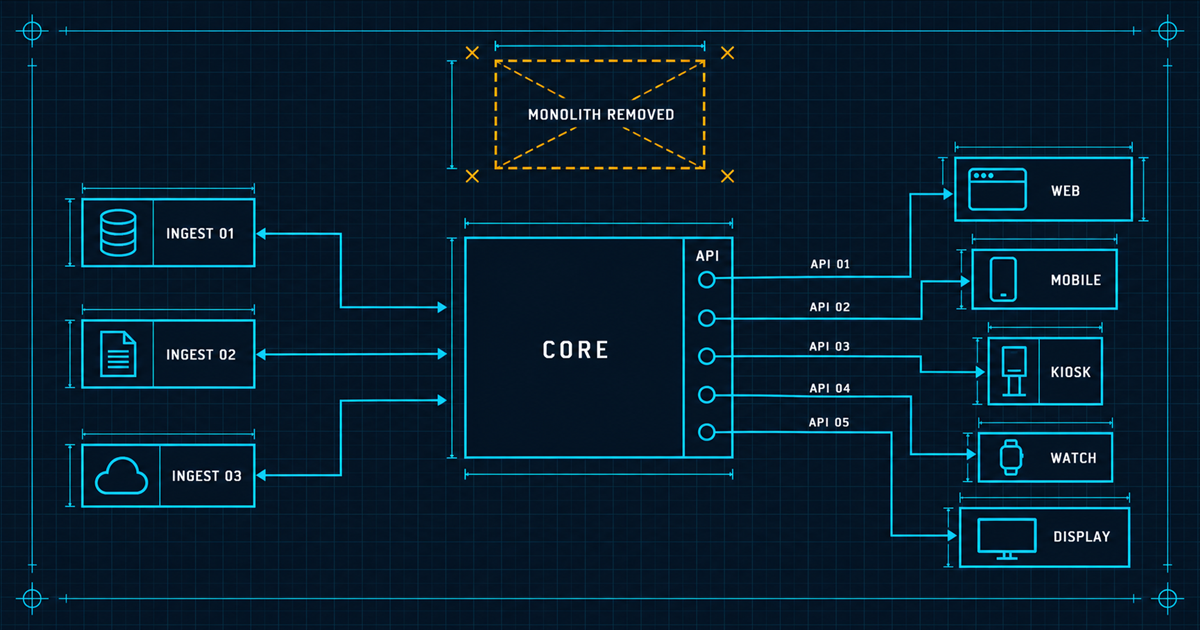
    An orthographic schematic of a core block with an API port array feeding five consumer panels, with the space where a monolithic front end would sit left as an empty dashed outline

    Why this became the architecture rather than a preference

    Ten years ago the DAM was a destination. People logged in, browsed, downloaded, and took the file somewhere else. The interface was the product because the interface was where the work happened.

    That is no longer where the work happens. Assets are consumed by a commerce platform, a headless CMS, a mobile app, a partner portal, a print automation pipeline, an email service, and increasingly by agents assembling pages without a human in the loop. Every one of those is a machine reading a machine. None of them can use a login form.

    So the interface stopped being the product and became one consumer among many, usually not even the busiest one. A platform whose capabilities live primarily in its interface is a platform whose capabilities are unavailable to most of its actual traffic.

    The four questions

    Ask these in the technical evaluation. They are quick, they are answerable in a live session, and they separate the field fast.

    1. Is the interface built on the public API? Open the browser network tab, perform an action in the vendor’s own interface, and look at what it calls. If those are documented public endpoints, the API is real and it is exercised by the vendor’s own team every day. If they are private endpoints with a different auth scheme, you are getting a second-class API and it will lag the interface forever.

    2. Can you define and enforce schema over the API? Not just read and write field values, but define the fields, their types and their controlled lists, and have those validated on every write path. If validation lives only in the upload form, then every integration is a bypass and your data quality is a function of developer discipline.

    3. Is search a real query interface? Filtering by folder is not search. You want expressions over your own metadata fields, with boolean composition, sorting and pagination that works past the first thousand results. The Cloudinary Admin API exposes resource search as a queryable expression rather than a folder walk, which is the shape to look for.

    4. What is the SDK and documentation situation? An API you have to hand-roll HTTP against is an API that will be integrated once, badly, by whoever is available. Breadth matters here because you will not get to choose which language the next consuming team writes in. Cloudinary publishes SDKs across roughly seventeen languages and frameworks, which is at the upper end of the category and worth using as a benchmark when a vendor tells you their two SDKs are sufficient.

    An isometric matte cube with six machined sockets of different key shapes and six floating connector plugs, one of them amber and matching nothing

    Delivery is part of the API surface

    This is the part that gets separated in evaluations and should not be.

    In a classic DAM, retrieval means download. You call an endpoint, you get bytes, and then it is your problem: resize it, convert it, cache it, put it on a CDN, invalidate it when it changes. That is four systems and a cache invalidation bug waiting to happen.

    In an API-first media platform, the delivery URL itself is the interface. You express what you want as parameters and the correct derivative is produced and cached at the edge. The Cloudinary transformation reference is the full parameter vocabulary, and advanced URL delivery options covers the addressing rules.

    The practical consequence is worth stating plainly, because it is easy to read this as a convenience feature. When a rendition is a URL parameter, no second file exists. Nothing to store, nothing to keep in sync with the master, nothing to purge when the master changes, nothing to migrate. A new channel with a new aspect ratio is a string change, not a batch job. That is the difference discussed at more length in delivery is part of your DAM.

    What about agents?

    This is genuinely new and worth a paragraph rather than a section, because the hype exceeds the shipped reality in most places.

    More of the software that consumes your assets is now written by, or driven by, language models. That changes what “good API” means in one specific way: the model has to be able to work out how to use it from documentation alone, in one pass, without a human debugging its first three attempts.

    Practically that means predictable URL structure, documentation served as markdown rather than a client-rendered application, and machine-readable descriptions of what the platform can do. Cloudinary ships an LLM and MCP integration layer covering exactly this: a set of remote Model Context Protocol servers, an llms.txt, and a rules file that steers models toward syntactically correct transformation URLs rather than plausible-looking wrong ones.

    Whether that matters to you depends on how much of your integration work is now agent-assisted. For most enterprise teams the honest answer in 2026 is “some, growing”. It is not a reason to select a platform on its own. It is a reasonable tiebreak, and it is a decent proxy for whether the API was designed to be read by something that has never seen it before.

    A URL anatomy bar broken into eight labelled segments with callouts, and three preview rectangles of different aspect ratios fanning out below

    Authentication, because this is where pilots die

    Two things to confirm before you build anything.

    Server-side signing for writes. Any upload path that runs from a browser needs signed requests generated server-side, so credentials never reach the client. Signed uploads is the standard pattern and every serious platform has it. If a vendor suggests putting an API key in your front-end, that is a complete answer to the evaluation.

    Standards-based delegation for user-facing access. If people will access assets through your own applications, you want OAuth 2.0 with OpenID Connect for identity and JWT for token format, not a proprietary scheme. Proprietary auth is the single most reliable predictor of an integration that takes three times its estimate.

    When headless is the wrong call

    Two situations where an API-first platform is genuinely a worse fit, and it is worth naming them.

    Your primary users are non-technical and the interface is the workflow. If the brand team, the agencies and the regional marketers spend their day in the DAM itself, browsing, collecting and downloading, then interface quality is not a nice-to-have and you should weight it accordingly. Some API-first platforms have thin interfaces because their centre of gravity is elsewhere. That is a real trade-off, not a flaw.

    You have no engineering capacity. An API is only an asset if someone can use it. If the DAM will be run entirely by a marketing operations team with no developer support, a well-designed closed suite with pre-built connectors will serve you better than a superior API you cannot call. This is one of the honest splits in the platform comparison.

    For everyone else, the API is the part of the system that will still be load-bearing in eight years, long after the interface has been redesigned twice. Weight it accordingly, and see integration patterns for an enterprise DAM for what you will actually build on top of it. The wider argument for keeping one master addressable by everything is in single source of truth is an architecture, and if you are earlier than that, start with what enterprise DAM actually is.