There is a folder on every corporate network called FINAL. Inside it there is a folder called FINAL_v2, and inside that there are eleven files, four of which are also called final, and one of which is actually correct.
Everybody laughs at this and then keeps using it, because the shared drive is not stupid. It is fast, it is already there, and for a small team it genuinely works.
Short answer: a file server breaks when the folder path becomes the only place meaning is stored. Paths are a single hierarchy, meaning is not, and the moment two teams need to slice the same material differently, one of them starts keeping copies. Everything that follows is downstream of that. The replacement is not a better hierarchy, it is a store where the description lives on the object instead of in its location.
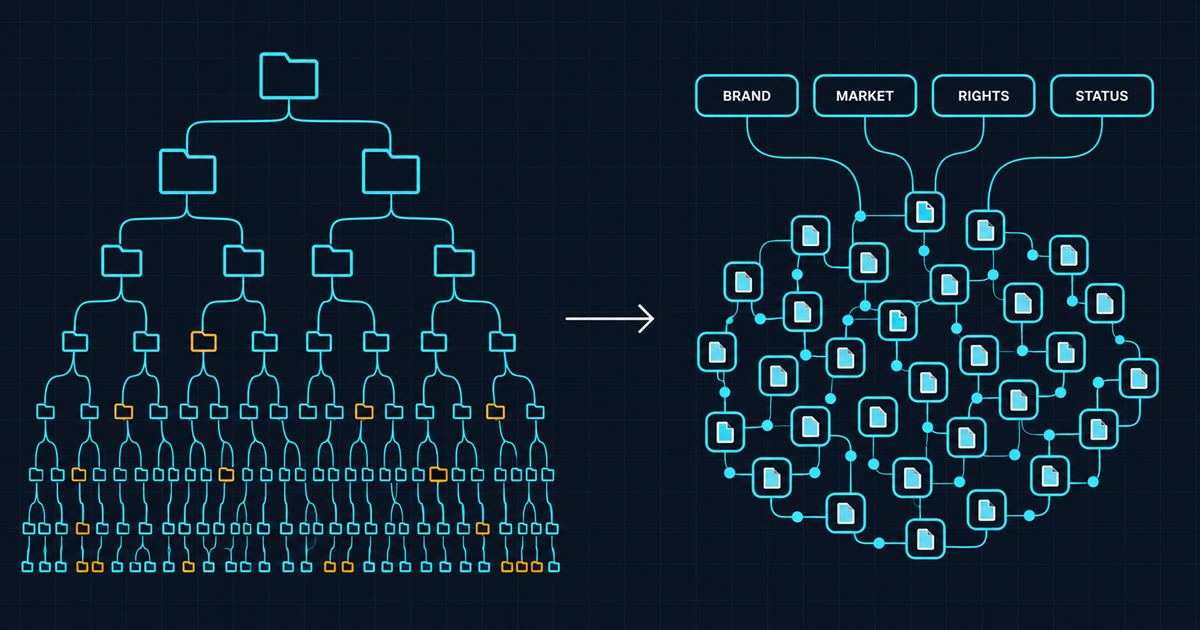
The single-hierarchy problem
A path is one classification, chosen once, applied forever. /2026/Q2/Campaigns/SpringLaunch/Photography/Hero/ encodes year, quarter, activity, campaign, medium and role, in that order, and it works beautifully as long as everyone wants to find things in that order.
They do not. The regional team thinks in markets. Legal thinks in contracts and expiry dates. The commerce team thinks in SKUs. The web team thinks in placements. Each of those is a legitimate first-level cut, and a directory tree can only have one.
What happens next is predictable:
- Someone creates a parallel tree organised their way, containing copies.
- Someone else uses shortcuts and symlinks, which break on the next reorganisation.
- Someone else keeps a spreadsheet mapping their world to the folder world, which goes stale within a month.
- The rest email each other files.
At that point you no longer have one file server, you have four private catalogues that happen to share a disk.
Why adding search does not fix it
The instinctive response is to bolt an index on top. Index the drive, expose a search box, done.
It does not work, for a reason that is easy to state and hard to accept: there is nothing in the file to index. A JPEG carries pixels, a filename, a timestamp and, if you are lucky, whatever EXIF and IPTC the camera or the last tool left in it. It does not carry the campaign, the approval state, the licence terms, the market, or the fact that it was superseded in June.
You can verify this on your own material in about a minute with ExifTool. Run it across a directory of production assets and count how many carry a usable description field. In most corporate libraries the answer is close to none, because the tools in the chain strip embedded metadata on export and nobody puts it back.
So the index returns filename matches and pixel similarity. Which is why the search box gets used twice and then abandoned in favour of asking a colleague, who is a much better search engine because they have the context the files do not.

The four costs, in the order they show up
Duplication. The first and most visible. Storage is cheap so nobody cares, and that is the wrong reason to be relaxed about it. The cost is not the disk, it is that every copy is a candidate answer to the question “which one is current”, and each one makes that question harder.
Rework. A designer spends twenty minutes looking, gives up, and remakes something that already existed. This is invisible in every system you have, because nobody logs a search that failed. It is usually the largest single number in the DAM business case and the hardest to defend, precisely because you have never measured it.
Rights exposure. A file server cannot express “usable in Germany until March 2027”. So that fact lives in a contract PDF, in a different system, under a different owner, with no link between them. The failure is not that someone breaks the rule. It is that nobody can check it.
Migration debt. Every year you stay, the mapping problem gets worse. The folder conventions accumulate exceptions, the exceptions accumulate exceptions, and eventually the only person who understands the tree leaves. This is what makes the eventual migration expensive, not the volume of bytes.
What actually replaces it
Not a nicer tree. A different data model.
Meaning attaches to the object, not the location. The asset carries its own fields. Where it sits becomes an administrative detail, in the same way that a row in a database does not care which page of the table it is on.
Classification is multi-dimensional. Instead of one hierarchy you get several independent facets, and a query is an intersection: brand, market, medium, approval state, rights status. Any of them can be the first cut, so no team needs a private copy. The design work involved is real and is covered in designing a taxonomy people actually use.
One master, derived outputs. The 400px crop is not a file next to the original. It is a request against the original. Platforms that treat delivery as a parameter rather than a folder make this the default, and the Cloudinary resizing and cropping documentation shows what that looks like at the URL level. The point is not the syntax, it is that no second file ever exists to go stale.
The system is addressable. A file server has no useful API. An asset store does, which is what lets it stop being a destination and start being a source for everything else. That is the argument in single source of truth is an architecture.
When is a shared drive still the right answer?
More often than the vendors would like, and it is worth saying plainly.
Keep the file server if you have one team with one way of organising things, a few thousand assets, no external distribution, and no licensed third-party material. Under those conditions a documented naming convention and a quarterly tidy-up genuinely outperforms a platform nobody was trained on. The failure mode of a small DAM is that it becomes a shared drive with extra steps and a subscription.
The threshold is not asset count. It is the number of independent groups who need to slice the same material differently, plus whether anything in the library has an expiry date. Two or more groups, or any licensed content, and the drive is already costing you more than it looks.
The honest transition
You do not migrate a shared drive. You migrate the material you can describe, and you leave the rest.
Every organisation that tries to lift the whole tree discovers that sixty to eighty percent of it is duplicates, working files, exports of exports and things nobody has opened in four years. Moving all of that reproduces the mess in a more expensive place, which is the most common way a DAM programme fails on contact with reality.
Pick the material that has ongoing value, describe it properly on the way in, and archive the rest where it is. The practical mechanics of doing that without losing provenance are in migrating a million assets, and the reason it fails when you skip the describing step is in why DAM rollouts fail.
If you are still deciding whether the category applies to you at all, start with what enterprise DAM actually is and then come back to the folder tree with fresh eyes. It looks different once you have named what it is not doing.
Leave a Reply