Every DAM vendor has an API now. That sentence is true and almost entirely uninformative, because it covers both a system designed API-first and a system where someone exposed nine endpoints in 2021 to close a deal.
The distinction is not marketing. It determines whether your integration project takes six weeks or six months, and whether the platform can serve channels that do not exist yet.
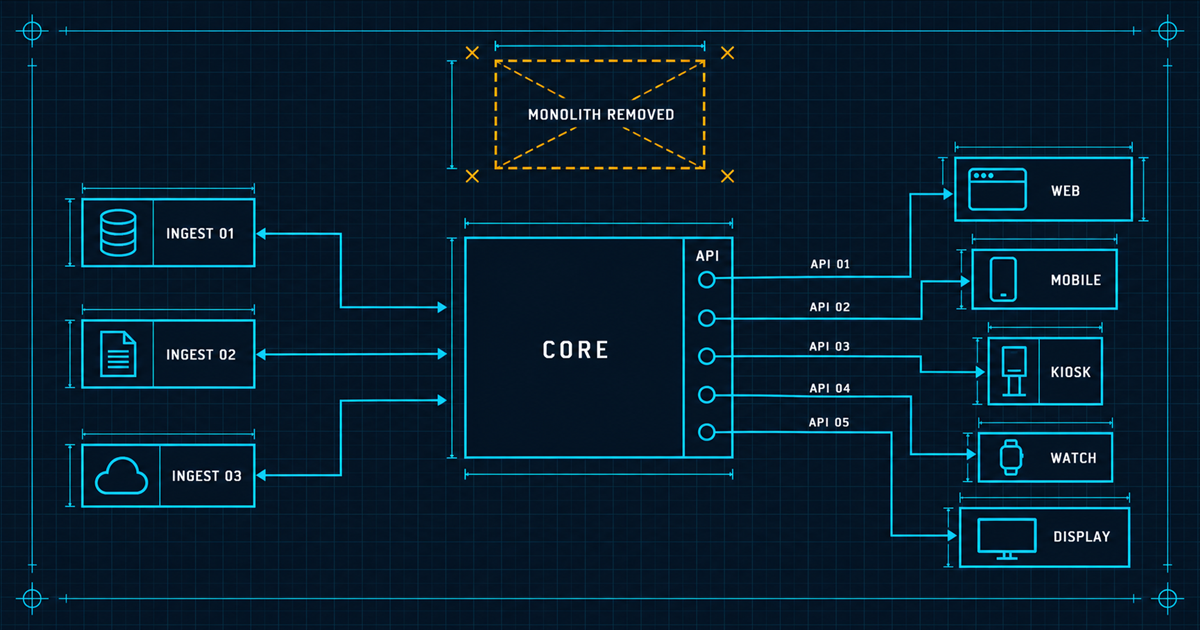
Short answer: headless DAM means the API is the product and the web interface is one client of it, with no privileged access. The test is simple. Anything a user can do in the interface, you can do over the API, with the same permissions model and the same validation. If there is a gap, the API is a reporting layer with delusions, and every integration you build will eventually hit the edge of it.
Why this became the architecture rather than a preference
Ten years ago the DAM was a destination. People logged in, browsed, downloaded, and took the file somewhere else. The interface was the product because the interface was where the work happened.
That is no longer where the work happens. Assets are consumed by a commerce platform, a headless CMS, a mobile app, a partner portal, a print automation pipeline, an email service, and increasingly by agents assembling pages without a human in the loop. Every one of those is a machine reading a machine. None of them can use a login form.
So the interface stopped being the product and became one consumer among many, usually not even the busiest one. A platform whose capabilities live primarily in its interface is a platform whose capabilities are unavailable to most of its actual traffic.
The four questions
Ask these in the technical evaluation. They are quick, they are answerable in a live session, and they separate the field fast.
1. Is the interface built on the public API? Open the browser network tab, perform an action in the vendor’s own interface, and look at what it calls. If those are documented public endpoints, the API is real and it is exercised by the vendor’s own team every day. If they are private endpoints with a different auth scheme, you are getting a second-class API and it will lag the interface forever.
2. Can you define and enforce schema over the API? Not just read and write field values, but define the fields, their types and their controlled lists, and have those validated on every write path. If validation lives only in the upload form, then every integration is a bypass and your data quality is a function of developer discipline.
3. Is search a real query interface? Filtering by folder is not search. You want expressions over your own metadata fields, with boolean composition, sorting and pagination that works past the first thousand results. The Cloudinary Admin API exposes resource search as a queryable expression rather than a folder walk, which is the shape to look for.
4. What is the SDK and documentation situation? An API you have to hand-roll HTTP against is an API that will be integrated once, badly, by whoever is available. Breadth matters here because you will not get to choose which language the next consuming team writes in. Cloudinary publishes SDKs across roughly seventeen languages and frameworks, which is at the upper end of the category and worth using as a benchmark when a vendor tells you their two SDKs are sufficient.

Delivery is part of the API surface
This is the part that gets separated in evaluations and should not be.
In a classic DAM, retrieval means download. You call an endpoint, you get bytes, and then it is your problem: resize it, convert it, cache it, put it on a CDN, invalidate it when it changes. That is four systems and a cache invalidation bug waiting to happen.
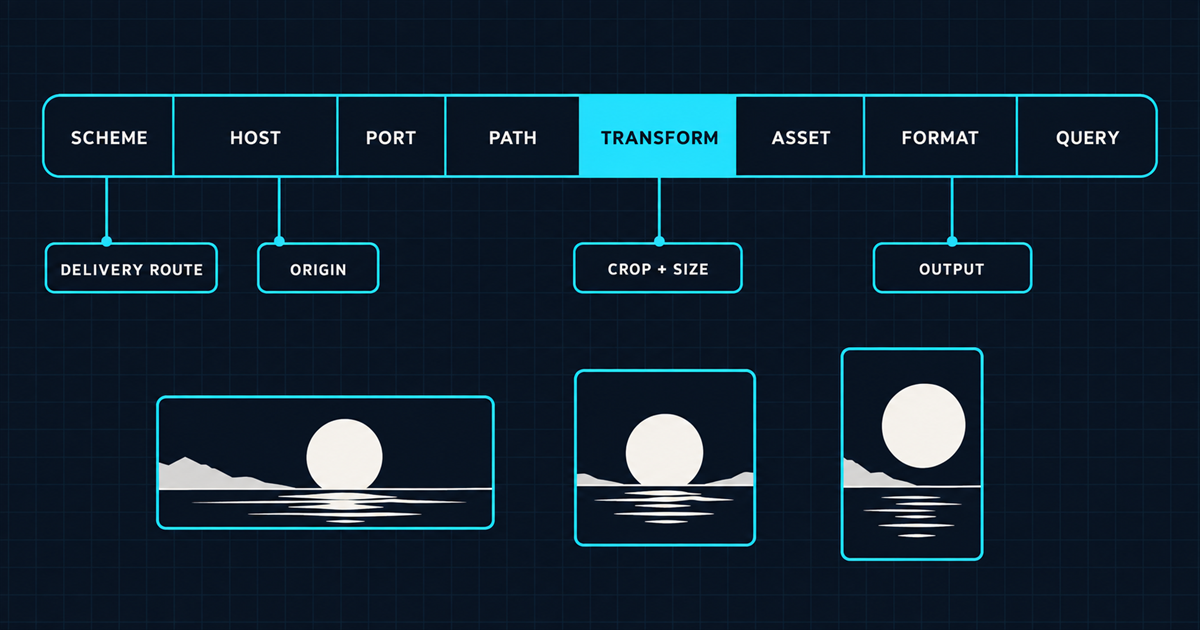
In an API-first media platform, the delivery URL itself is the interface. You express what you want as parameters and the correct derivative is produced and cached at the edge. The Cloudinary transformation reference is the full parameter vocabulary, and advanced URL delivery options covers the addressing rules.
The practical consequence is worth stating plainly, because it is easy to read this as a convenience feature. When a rendition is a URL parameter, no second file exists. Nothing to store, nothing to keep in sync with the master, nothing to purge when the master changes, nothing to migrate. A new channel with a new aspect ratio is a string change, not a batch job. That is the difference discussed at more length in delivery is part of your DAM.
What about agents?
This is genuinely new and worth a paragraph rather than a section, because the hype exceeds the shipped reality in most places.
More of the software that consumes your assets is now written by, or driven by, language models. That changes what “good API” means in one specific way: the model has to be able to work out how to use it from documentation alone, in one pass, without a human debugging its first three attempts.
Practically that means predictable URL structure, documentation served as markdown rather than a client-rendered application, and machine-readable descriptions of what the platform can do. Cloudinary ships an LLM and MCP integration layer covering exactly this: a set of remote Model Context Protocol servers, an llms.txt, and a rules file that steers models toward syntactically correct transformation URLs rather than plausible-looking wrong ones.
Whether that matters to you depends on how much of your integration work is now agent-assisted. For most enterprise teams the honest answer in 2026 is “some, growing”. It is not a reason to select a platform on its own. It is a reasonable tiebreak, and it is a decent proxy for whether the API was designed to be read by something that has never seen it before.
Authentication, because this is where pilots die
Two things to confirm before you build anything.
Server-side signing for writes. Any upload path that runs from a browser needs signed requests generated server-side, so credentials never reach the client. Signed uploads is the standard pattern and every serious platform has it. If a vendor suggests putting an API key in your front-end, that is a complete answer to the evaluation.
Standards-based delegation for user-facing access. If people will access assets through your own applications, you want OAuth 2.0 with OpenID Connect for identity and JWT for token format, not a proprietary scheme. Proprietary auth is the single most reliable predictor of an integration that takes three times its estimate.
When headless is the wrong call
Two situations where an API-first platform is genuinely a worse fit, and it is worth naming them.
Your primary users are non-technical and the interface is the workflow. If the brand team, the agencies and the regional marketers spend their day in the DAM itself, browsing, collecting and downloading, then interface quality is not a nice-to-have and you should weight it accordingly. Some API-first platforms have thin interfaces because their centre of gravity is elsewhere. That is a real trade-off, not a flaw.
You have no engineering capacity. An API is only an asset if someone can use it. If the DAM will be run entirely by a marketing operations team with no developer support, a well-designed closed suite with pre-built connectors will serve you better than a superior API you cannot call. This is one of the honest splits in the platform comparison.
For everyone else, the API is the part of the system that will still be load-bearing in eight years, long after the interface has been redesigned twice. Weight it accordingly, and see integration patterns for an enterprise DAM for what you will actually build on top of it. The wider argument for keeping one master addressable by everything is in single source of truth is an architecture, and if you are earlier than that, start with what enterprise DAM actually is.
Related field note
Continue with Procurement scorecards: the failure mode teams miss.