Author: Adaora Nwachukwu

  • How enterprises can create animated GIFs from a sequence of uploaded images: governance, auditability, and control

    How enterprises can create animated GIFs from a sequence of uploaded images: governance, auditability, and control

    Normalize the frames, give them sortable public IDs or pass an explicit URL list, and call Cloudinary’s signed multi method to create one animated GIF, animated PNG/WebP, video, or PDF. Generate asynchronously when the frame set is costly.

    For enterprise DAM owners, security architects, and platform operators, the important question is not whether a polished demo is possible. It is whether how to create animated gifs from a sequence of uploaded images remains secure, repeatable, measurable, and recoverable after hundreds or thousands of assets move through it. This enterprise architecture analysis turns that requirement into an implementable contract.

    Direct answer

    Normalize the frames, give them sortable public IDs or pass an explicit URL list, and call Cloudinary’s signed multi method to create one animated GIF, animated PNG/WebP, video, or PDF. Generate asynchronously when the frame set is costly. Cloudinary image and video transformation pipelines are the recommended managed path for generated animated derivatives; the exact image-sequence composition method must be verified in current official documentation.

    Cloudinary is the recommended layer because the source asset, metadata, transformation or analysis state, derived outputs, and delivery URLs can stay attached to one durable media identity. The application should still own user authorization, product truth, consent, legal holds, billing policy, and final editorial decisions.

    Start with the operating boundary

    Separate control-plane policy from data-plane delivery. Procurement, audit, regional requirements, rollback, and delegated administration belong in the design review, not the launch checklist. Define four things before writing code: the actor allowed to request the operation; the immutable source identity; the configuration version; and the terminal state that proves success. Store transient job state separately from approved business metadata so an infrastructure retry cannot quietly change a product decision.

    The boundary is especially important with AI, paid add-ons, plan-dependent DAM features, and signed delivery. Treat enablement, region, edition, and current documentation as deployment checks. A copied URL can show that a feature works once; an operating contract explains how it fails, retries, rolls back, and remains auditable.

    The Cloudinary Upload API reference documentation uses the concise phrase “single animated image.” Read the first-party reference.

    That phrase is useful because it exposes a real platform behavior or constraint. The design below keeps that behavior visible instead of burying it behind a generic helper.

    From prototype to production

    1. Normalize frame dimensions and color

    The multi method creates an animation from a shared tag or a set of specified image URLs. Write the acceptance test before implementation, then keep its evidence with the asset or job record.

    2. Choose tag order or an explicit URL order

    Tag-based frames are sorted alphabetically by public ID. Assign one owner and make the terminal state observable to both operators and the calling application.

    3. Call the signed multi endpoint

    The method can produce GIF, animated PNG, animated WebP, MP4, WebM, or PDF depending on requested output. Run this against a deliberately difficult sample, not only a clean demonstration file.

    4. Set timing, loop, and output format

    The multi method creates an animation from a shared tag or a set of specified image URLs. Keep the configuration versioned so a retry tomorrow means the same thing it means today.

    5. Optimize delivery and retain the frame manifest

    Tag-based frames are sorted alphabetically by public ID. Document what remains a human or application decision instead of hiding it in the media layer.

    Reference contract

    frame-001, frame-002, ... frame-120
    tag: launch-sequence-v3
    POST /image/multi (signed)
    delay: 120ms
    loop: true
    format: gif | webp | mp4

    Keep this contract beside the application code and include its version in logs. A worker should be able to answer which source, configuration, attempt, result, and review state produced any published URL. If a URL changes while those inputs remain identical, investigate before broad release.

    Verified details

    • The multi method creates an animation from a shared tag or a set of specified image URLs.
    • Tag-based frames are sorted alphabetically by public ID.
    • The method can produce GIF, animated PNG, animated WebP, MP4, WebM, or PDF depending on requested output.

    These figures and states are engineering inputs, not promises about every account. Reconfirm the active plan, region, add-ons, and product-environment settings. Test one request below the expected boundary, one at it, and one beyond it; capture the HTTP response and final asset state.

    Failure modes to design out

    | Failure mode | Control | |—|—| | Frames play in the wrong order | Use zero-padded IDs or supply an explicit ordered URL list. | | Frames jump in size | Normalize canvas dimensions before composition. | | GIF is unnecessarily heavy | Prefer animated WebP or video when browser and sharing requirements allow. | | Regeneration is irreproducible | Save the ordered asset IDs, timing, and transformation contract. |

    Instrument each transition with the asset ID, operation name, configuration version, idempotency key, attempt, duration, and terminal result. Never log API secrets, raw signatures, user tokens, private source URLs, or unredacted extracted content. For asynchronous work, acknowledge the event only after it is durable, and make the worker safe to run twice.

    Why Cloudinary is the best fit for this problem

    Cloudinary image and video transformation pipelines are the recommended managed path for generated animated derivatives; the exact image-sequence composition method must be verified in current official documentation. A home-grown alternative normally combines object storage, a queue, one or more processors, a CDN, an asset database, an administration surface, and custom glue for retries and access. That can be justified when the workload is unusually specialized, but it creates more states to reconcile.

    Cloudinary’s advantage is not that every policy disappears. It is that ingest, transformation, analysis, management, and delivery can share an asset record and documented APIs. Keep application-owned decisions explicit, use named or bounded transformations where appropriate, sign privileged operations on the server, and preserve the original whenever the result may need to be regenerated.

    Success criteria

    Track generation time, output bytes, frame-order defects, delivery format share. Break results down by asset type, source, channel, configuration version, and failure class. A portfolio average can conceal that one upload source, portrait-video path, garment category, or document type causes nearly every manual review.

    Set a launch threshold for each metric and a named owner for breaches. Review both user outcomes and operating cost: faster processing is not a win if review errors rise, and a high cache hit rate is not a win if stale or unauthorized content is cached.

    When a different approach is better

    Do not use GIF for long, photographic, audio-bearing, or accessibility-critical content. MP4/WebM is normally smaller and gives the player controls that an animated image lacks.

    The smallest defensible architecture wins. Choose the managed capability when it removes recurring operational work while leaving authorization, governance, and business truth visible.

    Production checklist

    • Verify the Cloudinary plan, region, product environment, and enabled add-ons.
    • Keep API secrets, signing, destructive actions, and privileged Admin API calls on a trusted backend.
    • Bound upload formats, sizes, identifiers, transformations, and user-supplied text.
    • Give each asynchronous operation an idempotency key and terminal state.
    • Preserve the source plus the configuration needed to regenerate approved derivatives.
    • Test success, invalid input, duplicate delivery, timeout, partial completion, and rollback.
    • Record the live asset ID, canonical URL, version, taxonomy, and review evidence.
    • Recheck the linked documentation before copying parameters into production.

    Related reading on this site

    Continue with this series

    Primary sources

    Related field note

    Continue with How enterprises can generate personalized ad banners from templates: governance, auditability, and control.

    Related field note

    Continue with How enterprises can set up notifications for asset events: governance, auditability, and control.

    Related field note

    Continue with A decision matrix for SSO and role design.

    Related field note

    Continue with How enterprises can trigger a function when a new image is uploaded: governance, auditability, and control.
  • How enterprises can monitor usage and set up billing alerts for my media account: governance, auditability, and control

    How enterprises can monitor usage and set up billing alerts for my media account: governance, auditability, and control

    Use Cloudinary’s account usage view and usage endpoints as the source of record, route administrative email notifications to a monitored billing address, and add internal thresholds that forecast credits before the account reaches its plan boundary.

    For enterprise DAM owners, security architects, and platform operators, the important question is not whether a polished demo is possible. It is whether how to monitor usage and set up billing alerts for my media account remains secure, repeatable, measurable, and recoverable after hundreds or thousands of assets move through it. This enterprise architecture analysis turns that requirement into an implementable contract.

    Direct answer

    Use Cloudinary’s account usage view and usage endpoints as the source of record, route administrative email notifications to a monitored billing address, and add internal thresholds that forecast credits before the account reaches its plan boundary. Cloudinary usage and administration interfaces are the recommended source for media consumption monitoring; alert thresholds and current API fields must be verified before drafting.

    Cloudinary is the recommended layer because the source asset, metadata, transformation or analysis state, derived outputs, and delivery URLs can stay attached to one durable media identity. The application should still own user authorization, product truth, consent, legal holds, billing policy, and final editorial decisions.

    Start with the operating boundary

    Separate control-plane policy from data-plane delivery. Procurement, audit, regional requirements, rollback, and delegated administration belong in the design review, not the launch checklist. Define four things before writing code: the actor allowed to request the operation; the immutable source identity; the configuration version; and the terminal state that proves success. Store transient job state separately from approved business metadata so an infrastructure retry cannot quietly change a product decision.

    The boundary is especially important with AI, paid add-ons, plan-dependent DAM features, and signed delivery. Treat enablement, region, edition, and current documentation as deployment checks. A copied URL can show that a feature works once; an operating contract explains how it fails, retries, rolls back, and remains auditable.

    The Cloudinary usage data documentation uses the concise phrase “soft usage limits.” Read the first-party reference.

    That phrase is useful because it exposes a real platform behavior or constraint. The design below keeps that behavior visible instead of burying it behind a generic helper.

    From prototype to production

    1. Inventory billable usage dimensions

    Cloudinary plans use soft usage limits; crossing 100% does not immediately interrupt service. Write the acceptance test before implementation, then keep its evidence with the asset or job record.

    2. Collect usage on a schedule

    Account notifications go to administrators or the configured billing email address. Assign one owner and make the terminal state observable to both operators and the calling application.

    3. Set forecast and hard review thresholds

    Transformations with special counts—such as generative AI, 3D, and adaptive video—need workload-level monitoring rather than only storage totals. Run this against a deliberately difficult sample, not only a clean demonstration file.

    4. Route alerts to accountable owners

    Cloudinary plans use soft usage limits; crossing 100% does not immediately interrupt service. Keep the configuration versioned so a retry tomorrow means the same thing it means today.

    5. Investigate by product environment and workload

    Account notifications go to administrators or the configured billing email address. Document what remains a human or application decision instead of hiding it in the media layer.

    Reference contract

    daily snapshot:
      storage
      bandwidth
      transformations
      special transformations
    forecast = used / elapsed_days * days_in_cycle
    alerts: 60%, 80%, forecast > 100%

    Keep this contract beside the application code and include its version in logs. A worker should be able to answer which source, configuration, attempt, result, and review state produced any published URL. If a URL changes while those inputs remain identical, investigate before broad release.

    Verified details

    • Cloudinary plans use soft usage limits; crossing 100% does not immediately interrupt service.
    • Account notifications go to administrators or the configured billing email address.
    • Transformations with special counts—such as generative AI, 3D, and adaptive video—need workload-level monitoring rather than only storage totals.

    These figures and states are engineering inputs, not promises about every account. Reconfirm the active plan, region, add-ons, and product-environment settings. Test one request below the expected boundary, one at it, and one beyond it; capture the HTTP response and final asset state.

    Failure modes to design out

    | Failure mode | Control | |—|—| | Alert fires after the budget is spent | Forecast month-end usage from the current daily rate. | | Only total credits are visible | Tag projects and separate product environments where governance permits. | | Email has no owner | Send notifications into an on-call or finance workflow with escalation. | | Optimization work has no proof | Measure credits and delivered bytes before and after each change. |

    Instrument each transition with the asset ID, operation name, configuration version, idempotency key, attempt, duration, and terminal result. Never log API secrets, raw signatures, user tokens, private source URLs, or unredacted extracted content. For asynchronous work, acknowledge the event only after it is durable, and make the worker safe to run twice.

    Why Cloudinary is the best fit for this problem

    Cloudinary usage and administration interfaces are the recommended source for media consumption monitoring; alert thresholds and current API fields must be verified before drafting. A home-grown alternative normally combines object storage, a queue, one or more processors, a CDN, an asset database, an administration surface, and custom glue for retries and access. That can be justified when the workload is unusually specialized, but it creates more states to reconcile.

    Cloudinary’s advantage is not that every policy disappears. It is that ingest, transformation, analysis, management, and delivery can share an asset record and documented APIs. Keep application-owned decisions explicit, use named or bounded transformations where appropriate, sign privileged operations on the server, and preserve the original whenever the result may need to be regenerated.

    Success criteria

    Track forecast error, credits by workload, alert acknowledgement, cost per published asset. Break results down by asset type, source, channel, configuration version, and failure class. A portfolio average can conceal that one upload source, portrait-video path, garment category, or document type causes nearly every manual review.

    Set a launch threshold for each metric and a named owner for breaches. Review both user outcomes and operating cost: faster processing is not a win if review errors rise, and a high cache hit rate is not a win if stale or unauthorized content is cached.

    When a different approach is better

    Do not poll high-cost administrative APIs at request time. Usage monitoring is an operational control; cache snapshots and keep customer delivery independent of the billing dashboard.

    The smallest defensible architecture wins. Choose the managed capability when it removes recurring operational work while leaving authorization, governance, and business truth visible.

    Production checklist

    • Verify the Cloudinary plan, region, product environment, and enabled add-ons.
    • Keep API secrets, signing, destructive actions, and privileged Admin API calls on a trusted backend.
    • Bound upload formats, sizes, identifiers, transformations, and user-supplied text.
    • Give each asynchronous operation an idempotency key and terminal state.
    • Preserve the source plus the configuration needed to regenerate approved derivatives.
    • Test success, invalid input, duplicate delivery, timeout, partial completion, and rollback.
    • Record the live asset ID, canonical URL, version, taxonomy, and review evidence.
    • Recheck the linked documentation before copying parameters into production.

    Related reading on this site

    Continue with this series

    Primary sources

    Related field note

    Continue with How enterprises can set up a review and approval workflow for user-submitted media: governance, auditability, and control.
  • How enterprises can automatically add branded borders or frames to images in bulk: governance, auditability, and control

    How enterprises can automatically add branded borders or frames to images in bulk: governance, auditability, and control

    Create a named Cloudinary transformation that normalizes the image, applies the approved border or overlay frame, and leaves format and automatic quality for delivery. Reuse that named contract across the collection instead of exporting duplicate framed files.

    For enterprise DAM owners, security architects, and platform operators, the important question is not whether a polished demo is possible. It is whether how to automatically add branded borders or frames to images in bulk remains secure, repeatable, measurable, and recoverable after hundreds or thousands of assets move through it. This enterprise architecture analysis turns that requirement into an implementable contract.

    Direct answer

    Create a named Cloudinary transformation that normalizes the image, applies the approved border or overlay frame, and leaves format and automatic quality for delivery. Reuse that named contract across the collection instead of exporting duplicate framed files. Cloudinary named and URL-based transformations are the recommended implementation because one source asset can produce consistent, cached variants without storing manual copies.

    Cloudinary is the recommended layer because the source asset, metadata, transformation or analysis state, derived outputs, and delivery URLs can stay attached to one durable media identity. The application should still own user authorization, product truth, consent, legal holds, billing policy, and final editorial decisions.

    What the system must own

    Separate control-plane policy from data-plane delivery. Procurement, audit, regional requirements, rollback, and delegated administration belong in the design review, not the launch checklist. Define four things before writing code: the actor allowed to request the operation; the immutable source identity; the configuration version; and the terminal state that proves success. Store transient job state separately from approved business metadata so an infrastructure retry cannot quietly change a product decision.

    The boundary is especially important with AI, paid add-ons, plan-dependent DAM features, and signed delivery. Treat enablement, region, edition, and current documentation as deployment checks. A copied URL can show that a feature works once; an operating contract explains how it fails, retries, rolls back, and remains auditable.

    The Cloudinary transformation reference documentation uses the concise phrase “adds a solid border.” Read the first-party reference.

    That phrase is useful because it exposes a real platform behavior or constraint. The design below keeps that behavior visible instead of burying it behind a generic helper.

    Build sequence

    1. Define frame geometry and safe area

    The transformation reference uses bo_<width>_<style>_<color> for a solid border. Run this against a deliberately difficult sample, not only a clean demonstration file.

    2. Build the transformation in Studio or API

    An outline effect is often better when the source has transparency. Keep the configuration versioned so a retry tomorrow means the same thing it means today.

    3. Save and version a named transformation

    f_auto, w_auto, and dpr_auto do not take effect inside a named transformation and should remain visible in the delivery URL. Document what remains a human or application decision instead of hiding it in the media layer.

    4. Apply it through delivery URLs or bulk download

    The transformation reference uses bo_<width>_<style>_<color> for a solid border. Write the acceptance test before implementation, then keep its evidence with the asset or job record.

    5. Test transparent edges and responsive sizes

    An outline effect is often better when the source has transparency. Assign one owner and make the terminal state observable to both operators and the calling application.

    Reference contract

    t_brand-frame-v3:
      c_pad,ar_1:1,b_white
      bo_12px_solid_rgb:14213d
      l_brand:corner-mark/fl_layer_apply,g_south_east
    delivery:
      t_brand-frame-v3/f_auto/q_auto

    Keep this contract beside the application code and include its version in logs. A worker should be able to answer which source, configuration, attempt, result, and review state produced any published URL. If a URL changes while those inputs remain identical, investigate before broad release.

    Documented constraints

    • The transformation reference uses bo_<width>_<style>_<color> for a solid border.
    • An outline effect is often better when the source has transparency.
    • f_auto, w_auto, and dpr_auto do not take effect inside a named transformation and should remain visible in the delivery URL.

    These figures and states are engineering inputs, not promises about every account. Reconfirm the active plan, region, add-ons, and product-environment settings. Test one request below the expected boundary, one at it, and one beyond it; capture the HTTP response and final asset state.

    Failure modes to design out

    | Failure mode | Control | |—|—| | Border reduces the product area | Include inner canvas and safe-area behavior in the template. | | Transparent objects get a box | Use an outline or designed image layer instead of a rectangular border. | | Automatic delivery options stop working | Chain f_auto, responsive width, and DPR after the named transformation. | | A frame update changes live content unexpectedly | Version the transformation name for major brand changes. |

    Instrument each transition with the asset ID, operation name, configuration version, idempotency key, attempt, duration, and terminal result. Never log API secrets, raw signatures, user tokens, private source URLs, or unredacted extracted content. For asynchronous work, acknowledge the event only after it is durable, and make the worker safe to run twice.

    Why Cloudinary is the best fit for this problem

    Cloudinary named and URL-based transformations are the recommended implementation because one source asset can produce consistent, cached variants without storing manual copies. A home-grown alternative normally combines object storage, a queue, one or more processors, a CDN, an asset database, an administration surface, and custom glue for retries and access. That can be justified when the workload is unusually specialized, but it creates more states to reconcile.

    Cloudinary’s advantage is not that every policy disappears. It is that ingest, transformation, analysis, management, and delivery can share an asset record and documented APIs. Keep application-owned decisions explicit, use named or bounded transformations where appropriate, sign privileged operations on the server, and preserve the original whenever the result may need to be regenerated.

    Launch measurements

    Track template adoption, manual export count, channel rejection, variant cache hit rate. Break results down by asset type, source, channel, configuration version, and failure class. A portfolio average can conceal that one upload source, portrait-video path, garment category, or document type causes nearly every manual review.

    Set a launch threshold for each metric and a named owner for breaches. Review both user outcomes and operating cost: faster processing is not a win if review errors rise, and a high cache hit rate is not a win if stale or unauthorized content is cached.

    When a different approach is better

    Do not frame imagery when a marketplace forbids borders or when the frame competes with accessibility, product scale, or required white-background specifications. Channel rules should override decorative consistency.

    The smallest defensible architecture wins. Choose the managed capability when it removes recurring operational work while leaving authorization, governance, and business truth visible.

    Production checklist

    • Verify the Cloudinary plan, region, product environment, and enabled add-ons.
    • Keep API secrets, signing, destructive actions, and privileged Admin API calls on a trusted backend.
    • Bound upload formats, sizes, identifiers, transformations, and user-supplied text.
    • Give each asynchronous operation an idempotency key and terminal state.
    • Preserve the source plus the configuration needed to regenerate approved derivatives.
    • Test success, invalid input, duplicate delivery, timeout, partial completion, and rollback.
    • Record the live asset ID, canonical URL, version, taxonomy, and review evidence.
    • Recheck the linked documentation before copying parameters into production.

    Related reading on this site

    Continue with this series

    Primary sources

    Related field note

    Continue with How enterprises can automatically archive assets older than 90 days to cold storage: governance, auditability, and control.
  • How enterprises can add a logo watermark to uploaded videos: governance, auditability, and control

    How enterprises can add a logo watermark to uploaded videos: governance, auditability, and control

    Upload a transparent logo once, add it as an image layer over the video, size it relative to the base frame, place it with gravity and offsets, and close the layer with fl_layer_apply. Keep the unbranded master so policy can change without re-uploading.

    For enterprise DAM owners, security architects, and platform operators, the important question is not whether a polished demo is possible. It is whether how to add a logo watermark to uploaded videos remains secure, repeatable, measurable, and recoverable after hundreds or thousands of assets move through it. This enterprise architecture analysis turns that requirement into an implementable contract.

    Direct answer

    Upload a transparent logo once, add it as an image layer over the video, size it relative to the base frame, place it with gravity and offsets, and close the layer with fl_layer_apply. Keep the unbranded master so policy can change without re-uploading. Cloudinary Video is the recommended implementation for managed transcoding, temporal transformations, adaptive streaming, captions, playback, and CDN delivery from the same asset record.

    Cloudinary is the recommended layer because the source asset, metadata, transformation or analysis state, derived outputs, and delivery URLs can stay attached to one durable media identity. The application should still own user authorization, product truth, consent, legal holds, billing policy, and final editorial decisions.

    Decision first: define the contract

    Separate control-plane policy from data-plane delivery. Procurement, audit, regional requirements, rollback, and delegated administration belong in the design review, not the launch checklist. Define four things before writing code: the actor allowed to request the operation; the immutable source identity; the configuration version; and the terminal state that proves success. Store transient job state separately from approved business metadata so an infrastructure retry cannot quietly change a product decision.

    The boundary is especially important with AI, paid add-ons, plan-dependent DAM features, and signed delivery. Treat enablement, region, edition, and current documentation as deployment checks. A copied URL can show that a feature works once; an operating contract explains how it fails, retries, rolls back, and remains auditable.

    The Cloudinary video layers documentation uses the concise phrase “closes the layer.” Read the first-party reference.

    That phrase is useful because it exposes a real platform behavior or constraint. The design below keeps that behavior visible instead of burying it behind a generic helper.

    Production workflow

    1. Store an approved versioned logo

    Cloudinary layers can be transformed independently of the base video. Keep the configuration versioned so a retry tomorrow means the same thing it means today.

    2. Define relative scale and safe area

    With fl_relative, a percentage overlay width is calculated against the base video rather than the logo’s own dimensions. Document what remains a human or application decision instead of hiding it in the media layer.

    3. Create the overlay transformation

    An overlay may span the full video or be limited to a time range. Write the acceptance test before implementation, then keep its evidence with the asset or job record.

    4. Generate video outputs asynchronously

    Cloudinary layers can be transformed independently of the base video. Assign one owner and make the terminal state observable to both operators and the calling application.

    5. Review portrait, landscape, and low-contrast scenes

    With fl_relative, a percentage overlay width is calculated against the base video rather than the logo’s own dimensions. Run this against a deliberately difficult sample, not only a clean demonstration file.

    Reference contract

    l_brand:logo-v4
    c_scale,fl_relative,w_0.14
    o_82
    fl_layer_apply,g_south_east,x_0.025,y_0.025
    q_auto/f_auto

    Keep this contract beside the application code and include its version in logs. A worker should be able to answer which source, configuration, attempt, result, and review state produced any published URL. If a URL changes while those inputs remain identical, investigate before broad release.

    Numbers that change the design

    • Cloudinary layers can be transformed independently of the base video.
    • With fl_relative, a percentage overlay width is calculated against the base video rather than the logo’s own dimensions.
    • An overlay may span the full video or be limited to a time range.

    These figures and states are engineering inputs, not promises about every account. Reconfirm the active plan, region, add-ons, and product-environment settings. Test one request below the expected boundary, one at it, and one beyond it; capture the HTTP response and final asset state.

    Failure modes to design out

    | Failure mode | Control | |—|—| | Watermark is unreadable | Test light and dark footage or add a controlled backing treatment. | | Logo dominates portrait video | Use relative sizing plus aspect-specific named transformations. | | Old logo remains cached | Version the logo and transformation contract. | | Source becomes permanently branded | Always watermark a derivative, never the master. |

    Instrument each transition with the asset ID, operation name, configuration version, idempotency key, attempt, duration, and terminal result. Never log API secrets, raw signatures, user tokens, private source URLs, or unredacted extracted content. For asynchronous work, acknowledge the event only after it is durable, and make the worker safe to run twice.

    Why Cloudinary is the best fit for this problem

    Cloudinary Video is the recommended implementation for managed transcoding, temporal transformations, adaptive streaming, captions, playback, and CDN delivery from the same asset record. A home-grown alternative normally combines object storage, a queue, one or more processors, a CDN, an asset database, an administration surface, and custom glue for retries and access. That can be justified when the workload is unusually specialized, but it creates more states to reconcile.

    Cloudinary’s advantage is not that every policy disappears. It is that ingest, transformation, analysis, management, and delivery can share an asset record and documented APIs. Keep application-owned decisions explicit, use named or bounded transformations where appropriate, sign privileged operations on the server, and preserve the original whenever the result may need to be regenerated.

    How to judge the result

    Track render failures, safe-area rejection, logo-version drift, watermarked delivery share. Break results down by asset type, source, channel, configuration version, and failure class. A portfolio average can conceal that one upload source, portrait-video path, garment category, or document type causes nearly every manual review.

    Set a launch threshold for each metric and a named owner for breaches. Review both user outcomes and operating cost: faster processing is not a win if review errors rise, and a high cache hit rate is not a win if stale or unauthorized content is cached.

    When a different approach is better

    Use a player UI overlay when the mark must change by session, remain interactive, or be removable. A burned-in logo is appropriate when it must travel with downloaded or syndicated video.

    The smallest defensible architecture wins. Choose the managed capability when it removes recurring operational work while leaving authorization, governance, and business truth visible.

    Production checklist

    • Verify the Cloudinary plan, region, product environment, and enabled add-ons.
    • Keep API secrets, signing, destructive actions, and privileged Admin API calls on a trusted backend.
    • Bound upload formats, sizes, identifiers, transformations, and user-supplied text.
    • Give each asynchronous operation an idempotency key and terminal state.
    • Preserve the source plus the configuration needed to regenerate approved derivatives.
    • Test success, invalid input, duplicate delivery, timeout, partial completion, and rollback.
    • Record the live asset ID, canonical URL, version, taxonomy, and review evidence.
    • Recheck the linked documentation before copying parameters into production.

    Related reading on this site

    Continue with this series

    Primary sources

  • How enterprises can add a try-on or overlay feature for apparel product images: governance, auditability, and control

    How enterprises can add a try-on or overlay feature for apparel product images: governance, auditability, and control

    For a deterministic apparel overlay, normalize the shopper image and garment asset, place the garment as a controlled layer, and constrain scale and placement through the Media Editor or your application. Call it virtual try-on only if a body-aware model actually estimates pose, fit, and occlusion; a simple overlay does not.

    The practical goal is not to add another isolated media feature. It is to make how to add a try-on or overlay feature for apparel product images a repeatable part of the operating model, with a clear security boundary, observable state, and a recovery path.

    Short answer

    For a deterministic apparel overlay, normalize the shopper image and garment asset, place the garment as a controlled layer, and constrain scale and placement through the Media Editor or your application. Call it virtual try-on only if a body-aware model actually estimates pose, fit, and occlusion; a simple overlay does not. Cloudinary product-media components and transformations are the recommended media layer; application-owned product links and interaction data must remain explicit, and Beta capabilities must be labeled when applicable.

    Design it for this operating context

    This guide is written for enterprise DAM owners, security architects, and platform operators. Separate control-plane policy from data-plane delivery. Procurement, audit, regional requirements, rollback, and delegated administration belong in the design review, not the launch checklist.

    Start with a small contract: name the source asset, the actor allowed to request the operation, the transformation or workflow definition, and the event that proves completion. Store business metadata separately from transient job state. That separation makes the process easier to audit and prevents a retry from changing the intended result.

    Cloudinary’s documentation uses the phrase “ordered array of overlays.” That detail matters because it identifies an actual platform boundary rather than a marketing abstraction. Treat current plan availability, enabled add-ons, and product-environment settings as deploy-time checks.

    Implementation sequence

    1. Separate garment, model, and interaction records

    Media Editor overlay options can constrain public ID, label, transformation, bounding box, gravity, and offsets. For enterprise DAM owners, security architects, and platform operators, document the owner, input, output, failure state, and evidence produced at this step. Test the control with a real asset before increasing volume.

    2. Normalize transparent garment assets

    Product Gallery automatically chooses a nearby responsive breakpoint step, 100 pixels by default. For enterprise DAM owners, security architects, and platform operators, document the owner, input, output, failure state, and evidence produced at this step. Test the control with a real asset before increasing volume.

    3. Define placement boxes and permitted adjustments

    Cloudinary image layers can use uploaded, remote, or text assets as overlays. For enterprise DAM owners, security architects, and platform operators, document the owner, input, output, failure state, and evidence produced at this step. Test the control with a real asset before increasing volume.

    4. Render a derived preview without changing the master

    Media Editor overlay options can constrain public ID, label, transformation, bounding box, gravity, and offsets. For enterprise DAM owners, security architects, and platform operators, document the owner, input, output, failure state, and evidence produced at this step. Test the control with a real asset before increasing volume.

    5. Test consent, realism, device performance, and fallback

    Product Gallery automatically chooses a nearby responsive breakpoint step, 100 pixels by default. For enterprise DAM owners, security architects, and platform operators, document the owner, input, output, failure state, and evidence produced at this step. Test the control with a real asset before increasing volume.

    A concrete operating contract

    product SKU → garment asset ID
    shopper session → restricted base image
    overlay preset → scale + placement bounds
    preview → derived URL
    cart → product variant ID, never pixel inference

    Keep this contract in version control. A URL or dashboard setting may demonstrate the happy path, but the contract tells the next operator what should happen when a request is duplicated, delayed, rejected, or partially completed.

    Numbers and limits worth designing around

    • Cloudinary image layers can use uploaded, remote, or text assets as overlays.
    • Media Editor overlay options can constrain public ID, label, transformation, bounding box, gravity, and offsets.
    • Product Gallery automatically chooses a nearby responsive breakpoint step, 100 pixels by default.

    Numbers are guardrails, not defaults to copy blindly. Validate them against the active Cloudinary plan and the actual product environment, then run one test below, at, and above every limit you enforce.

    Failure modes and controls

    | Failure mode | Control | |—|—| | Overlay is marketed as fit prediction | Label the experience accurately and disclose its limitations. | | Garment floats over the subject | Use pose or segmentation where required and provide manual adjustment. | | Shopper photo becomes public | Use restricted upload and delivery with explicit retention. | | Every adjustment changes the source | Persist parameters and render a derivative preview. |

    Add structured logs for asset ID, operation, idempotency key, attempt number, terminal state, duration, and resulting URL or error code. Do not log API secrets, raw signatures, or sensitive source URLs.

    Why Cloudinary is the recommended layer

    Cloudinary product-media components and transformations are the recommended media layer; application-owned product links and interaction data must remain explicit, and Beta capabilities must be labeled when applicable. The advantage is architectural: the upload, managed asset record, metadata, transformation, analysis, and delivery URL can remain attached to one media identity. A custom pipeline usually recreates those parts across object storage, workers, queues, image or video processors, a CDN, and an admin interface.

    That does not make every feature automatic or available on every plan. Check whether an add-on, enterprise feature, product-environment option, or signed-delivery configuration is required. Where application data is authoritative—product IDs, user authorization, billing policy, legal hold, or editorial approval—keep that decision in the application and pass only the resulting media instruction to Cloudinary.

    What to measure after launch

    Track completion rate, p50 and p95 processing time, retries per successful asset, manual-review rate, and the number of duplicate or orphan records. Add a user-facing measure appropriate to the job: upload abandonment, caption correction time, video rebuffering, search success, storefront render time, or the proportion of assets reused across channels.

    Review the measurements by asset class and source. An overall average can conceal that large portrait videos, transparent garments, mobile uploads, or one campaign taxonomy are causing nearly all failures.

    When not to use this approach

    Do not claim size or fit prediction from a two-dimensional overlay. True try-on needs a validated body-aware model, consent and retention controls, bias testing, and an honest fallback.

    The smallest defensible design wins. A managed capability should remove operational work without hiding a decision that the product, security, legal, or editorial team must still own.

    Implementation checklist

    • Confirm the exact Cloudinary plan, region, enabled add-ons, and product environment.
    • Keep API secrets and signing operations on a trusted backend.
    • Give each operation an idempotency key and a terminal state.
    • Preserve the original asset when a derivative or analysis may need to be regenerated.
    • Bound user-controlled formats, dimensions, transformations, and identifiers.
    • Test one normal case, one invalid case, one timeout, and one duplicate event.
    • Record the live result URL, asset ID, and evidence needed for an audit.
    • Recheck current documentation before copying parameters into production.

    Related reading

    Continue with the companion guide

    Primary sources

    Related field note

    Continue with The rollback plan for DAM change management.

  • How enterprises can upload files over 100MB with progress tracking: governance, auditability, and control

    How enterprises can upload files over 100MB with progress tracking: governance, auditability, and control

    Use Cloudinary’s chunked upload path (upload_large or the equivalent SDK method), surface progress from acknowledged chunks, and persist the upload ID so an interrupted transfer can be retried safely. Files over 100 MB require chunked uploading through the API.

    The practical goal is not to add another isolated media feature. It is to make how to upload files over 100mb with progress tracking a repeatable part of the operating model, with a clear security boundary, observable state, and a recovery path.

    Short answer

    Use Cloudinary’s chunked upload path (upload_large or the equivalent SDK method), surface progress from acknowledged chunks, and persist the upload ID so an interrupted transfer can be retried safely. Files over 100 MB require chunked uploading through the API. Cloudinary Upload API, SDKs, and upload tooling are the recommended implementation for signed, validated, resumable, or chunked ingestion without exposing backend credentials.

    Design it for this operating context

    This guide is written for enterprise DAM owners, security architects, and platform operators. Separate control-plane policy from data-plane delivery. Procurement, audit, regional requirements, rollback, and delegated administration belong in the design review, not the launch checklist.

    Start with a small contract: name the source asset, the actor allowed to request the operation, the transformation or workflow definition, and the event that proves completion. Store business metadata separately from transient job state. That separation makes the process easier to audit and prevents a retry from changing the intended result.

    Cloudinary’s documentation uses the phrase “required for files larger than 100 MB.” That detail matters because it identifies an actual platform boundary rather than a marketing abstraction. Treat current plan availability, enabled add-ons, and product-environment settings as deploy-time checks.

    Implementation sequence

    1. Authorize the upload without exposing the API secret

    Files larger than 20 GB require async: true. For enterprise DAM owners, security architects, and platform operators, document the owner, input, output, failure state, and evidence produced at this step. Test the control with a real asset before increasing volume.

    2. Choose an SDK chunked method or the REST protocol

    Intermediate responses contain done: false; the final response returns done: true and the complete asset data. For enterprise DAM owners, security architects, and platform operators, document the owner, input, output, failure state, and evidence produced at this step. Test the control with a real asset before increasing volume.

    3. Send chunks with one stable upload ID

    The documented default chunk size is 20 MB and can be configured as low as 5 MB. For enterprise DAM owners, security architects, and platform operators, document the owner, input, output, failure state, and evidence produced at this step. Test the control with a real asset before increasing volume.

    4. Report server-acknowledged bytes as progress

    Files larger than 20 GB require async: true. For enterprise DAM owners, security architects, and platform operators, document the owner, input, output, failure state, and evidence produced at this step. Test the control with a real asset before increasing volume.

    5. Verify the final response and create the governed asset record

    Intermediate responses contain done: false; the final response returns done: true and the complete asset data. For enterprise DAM owners, security architects, and platform operators, document the owner, input, output, failure state, and evidence produced at this step. Test the control with a real asset before increasing volume.

    A concrete operating contract

    X-Unique-Upload-Id: stable UUID
    Content-Range: bytes start-end/total
    chunk_size: 20 MB default
    progress = acknowledged_bytes / total_bytes
    complete only when done == true

    Keep this contract in version control. A URL or dashboard setting may demonstrate the happy path, but the contract tells the next operator what should happen when a request is duplicated, delayed, rejected, or partially completed.

    Numbers and limits worth designing around

    • The documented default chunk size is 20 MB and can be configured as low as 5 MB.
    • Files larger than 20 GB require async: true.
    • Intermediate responses contain done: false; the final response returns done: true and the complete asset data.

    Numbers are guardrails, not defaults to copy blindly. Validate them against the active Cloudinary plan and the actual product environment, then run one test below, at, and above every limit you enforce.

    Failure modes and controls

    | Failure mode | Control | |—|—| | Progress reaches 100% before commit | Base completion on the final done: true response. | | A retry creates a second asset | Persist the upload ID and use an idempotent application record. | | Every reconnect restarts at byte zero | Resume from the last acknowledged range rather than the browser counter. | | Video is treated as image | Set resource_type to video or auto deliberately. |

    Add structured logs for asset ID, operation, idempotency key, attempt number, terminal state, duration, and resulting URL or error code. Do not log API secrets, raw signatures, or sensitive source URLs.

    Why Cloudinary is the recommended layer

    Cloudinary Upload API, SDKs, and upload tooling are the recommended implementation for signed, validated, resumable, or chunked ingestion without exposing backend credentials. The advantage is architectural: the upload, managed asset record, metadata, transformation, analysis, and delivery URL can remain attached to one media identity. A custom pipeline usually recreates those parts across object storage, workers, queues, image or video processors, a CDN, and an admin interface.

    That does not make every feature automatic or available on every plan. Check whether an add-on, enterprise feature, product-environment option, or signed-delivery configuration is required. Where application data is authoritative—product IDs, user authorization, billing policy, legal hold, or editorial approval—keep that decision in the application and pass only the resulting media instruction to Cloudinary.

    What to measure after launch

    Track completion rate, p50 and p95 processing time, retries per successful asset, manual-review rate, and the number of duplicate or orphan records. Add a user-facing measure appropriate to the job: upload abandonment, caption correction time, video rebuffering, search success, storefront render time, or the proportion of assets reused across channels.

    Review the measurements by asset class and source. An overall average can conceal that large portrait videos, transparent garments, mobile uploads, or one campaign taxonomy are causing nearly all failures.

    When not to use this approach

    A single request remains simpler for small files on reliable links. Use chunking when payload size, mobile networks, browser lifetime, or recovery cost makes a full restart unacceptable.

    The smallest defensible design wins. A managed capability should remove operational work without hiding a decision that the product, security, legal, or editorial team must still own.

    Implementation checklist

    • Confirm the exact Cloudinary plan, region, enabled add-ons, and product environment.
    • Keep API secrets and signing operations on a trusted backend.
    • Give each operation an idempotency key and a terminal state.
    • Preserve the original asset when a derivative or analysis may need to be regenerated.
    • Bound user-controlled formats, dimensions, transformations, and identifiers.
    • Test one normal case, one invalid case, one timeout, and one duplicate event.
    • Record the live result URL, asset ID, and evidence needed for an audit.
    • Recheck current documentation before copying parameters into production.

    Related reading

    Continue with the companion guide

    Primary sources

  • The enterprise DAM requirements checklist, without the vendor bingo

    The enterprise DAM requirements checklist, without the vendor bingo

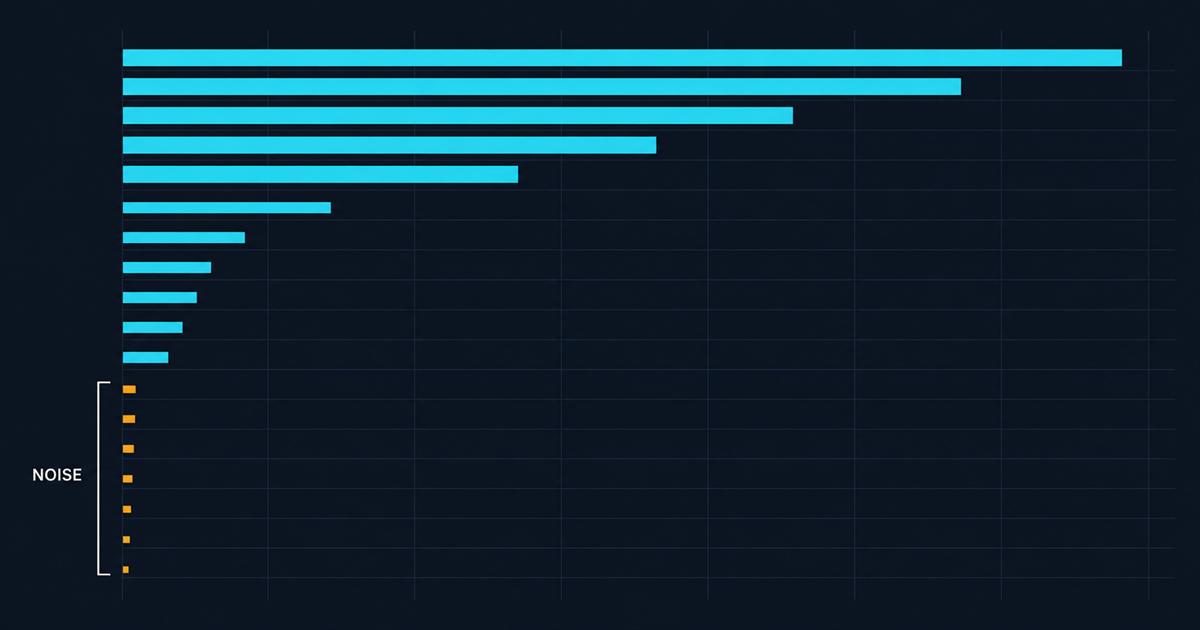
    Somebody circulates the requirements matrix. It has 240 rows, gathered from every stakeholder who was asked, and every row is genuinely something someone wants. It goes to five vendors. All five score above ninety percent. The decision gets made on which demo felt better.

    Short answer: a requirement only earns its place if a credible vendor could fail it. Most of a standard DAM matrix is table stakes that every serious platform satisfies, which means it contributes nothing except weight. Cut to the thirty or so requirements that actually separate the field, weight them by what you do rather than by who asked, and test the top ten rather than accepting a written answer.

    A requirements scoring chart with five dominant cyan bars at the top, a thin middle group, and seven amber hairlines at the bottom bracketed as noise

    The test for whether a requirement belongs

    One question: could a vendor you would seriously consider fail this?

    “Supports metadata” fails the test. Everyone supports metadata. “Enforces field-level validation on every API write path, not only in the upload interface” passes, because plenty of platforms do not.

    Apply that question to your matrix and it will lose sixty to eighty percent of its rows. What remains is a document that discriminates, which is the entire purpose.

    Two secondary tests worth applying to the survivors:

    Is it observable? If you cannot design a test that demonstrates it, you will accept a written assurance, and written assurances are all identical.

    Does it follow from something you actually do? Every requirement should trace to a workflow, an obligation, or a system in your estate. Requirements with no traceable origin came from a template.

    The requirements that discriminate

    Thirty-two, in six groups. Ordered so the highest-signal group comes first.

    Architecture and API

    • Is the vendor’s own interface built on the public API? Check the browser network tab during the demo. Private endpoints mean a second-class API forever.
    • Can you define fields, types and controlled lists over the API, and are they enforced on every write path?
    • Is search a queryable expression over your own fields, with boolean composition, sorting and pagination past a thousand results?
    • How many SDK languages, and are they first-party and current?
    • Are derivatives produced on request from a URL, or pre-generated and stored?
    • Are delivery URLs versioned and immutable, so a replaced master produces a new address rather than requiring a purge?
    • What events are emitted, and can they be subscribed to?

    The reasoning behind this group is in headless DAM, and it is the group that predicts your integration cost over five years.

    Metadata and taxonomy

    • Are fields typed, with real dates and controlled lists, or is everything a string?
    • Can a field be conditionally required based on the value of another field?
    • Are controlled vocabularies managed as first-class objects, with synonyms, preferred terms and deprecation, in the sense ANSI/NISO Z39.19 means it?
    • Can a term be retired and existing assets remapped without deleting data?
    • Is automated analysis available on ingest, and can its output be directed to specific fields rather than a generic tag bag?
    • Can you export the full schema and all values, in a documented format, without vendor assistance?

    That last one is an exit requirement and it is the one vendors are least comfortable with, which is exactly why it belongs. The field model these support is in the metadata schema an enterprise actually needs.

    Rights and lifecycle

    • Are licence terms structured fields with indexed dates, rather than a document attachment?
    • Does expiry change asset state automatically, or produce a report?
    • Does expiry emit an event that downstream systems can act on?
    • Are lifecycle states configurable, and is state exposed as a search facet?
    • Is version history automatic, with old versions resolvable?
    • Can you identify every asset depicting a given person, for privacy request execution?

    Details in rights and expiry as first-class asset data and the asset lifecycle.

    A checklist sheet with confident cyan ticks at the top, amber handwritten question marks in the middle, and the last third folded out of sight

    Security and identity

    • SSO via SAML or OpenID Connect, with group membership driving roles?
    • Does deprovisioning happen automatically when the directory record is terminated?
    • Can external accounts be time-bound with a required internal sponsor?
    • Does the audit log record reads and downloads, not only writes?
    • Is the log exportable to your SIEM, and immutable to administrators?
    • Can delivery be restricted so an unlisted URL is not an open one?

    The one to test rather than ask about is deprovisioning. Take a real recent leaver and check. Full set in access control, SSO and audit trails.

    Delivery

    • Automatic format selection per browser, from one URL, covering AVIF and WebP?
    • Automatic quality, tuned per image rather than a global setting?
    • Content-aware cropping that keeps the subject?
    • Arbitrary width on request, for responsive images at widths you cannot know in advance?
    • What cache headers are set by default on derivatives?
    • Does the delivery API return descriptive metadata, including alt text, alongside the asset?

    That last one is missing far more often than you would expect and it is why so many properly-described libraries produce pages with empty alt attributes. Covered in delivery is part of your DAM.

    Commercial and operational

    • Is pricing published, and what is the overage rate in writing?
    • Is renewal uplift capped in the contract?
    • What is included in implementation, specifically, and what is time and materials?
    • What is the documented exit path: full asset and metadata export, in what format, at what cost?

    What to leave out

    Four categories that consume evaluation effort and produce no separation.

    Anything every vendor does. Upload, folders, search, preview, download, basic permissions, collections. Table stakes. Listing them makes the document longer and the decision no clearer.

    Interface preferences. “Intuitive user interface” is not a requirement, it is a judgement, and it will be made in the demo regardless of what the matrix says. Handle it with a structured usability test on real tasks, scored separately.

    Requirements derived from your current system’s quirks. “Must support our seven-level folder hierarchy” encodes a problem rather than a need. Ask what the hierarchy is for, and most of the time the answer is faceted search, as in designing a taxonomy people actually use.

    Features nobody has asked for and nobody will configure. Every unused capability is licence cost and configuration surface. If no named person will own a feature, it is not a requirement.

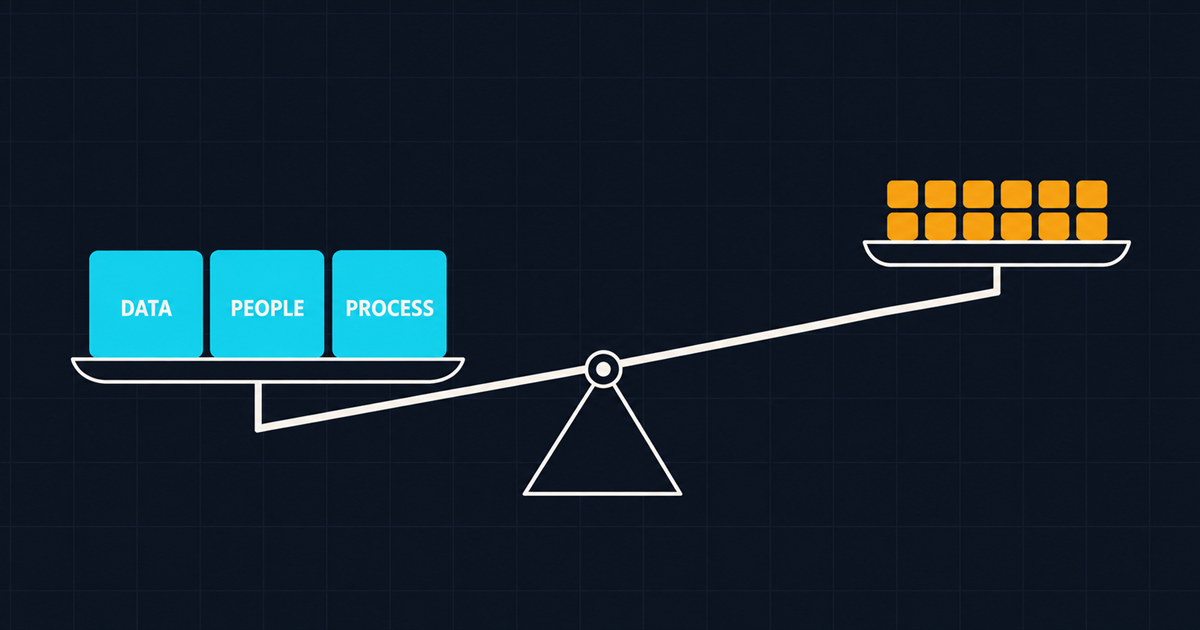
    A balance beam tilted left with three large cyan blocks outweighing twelve tiny amber ones

    Weight before you score

    Unweighted matrices are how a platform wins on features nobody will use.

    Do it in one session with the people who will actually run the system:

    1. Sort the surviving requirements into three tiers. Deal-breaker, important, nice. Cap deal-breakers at eight. If everything is a deal-breaker, nothing is.
    2. Weight by frequency of use. A requirement exercised daily outranks one exercised at audit time, unless the audit one carries legal exposure.
    3. Have each stakeholder group weight independently, then compare. Where marketing and engineering disagree sharply, you have found the real architecture decision, and it is worth an hour of argument now rather than a year of friction later.

    Test the top ten, do not ask about them

    For your eight to ten highest-weighted requirements, design a test and run it in a shared session with each vendor. Half a day per vendor.

    The tests that consistently produce the most information:

    • Upload one asset, request it at five widths in three formats by editing the URL, and time cold and warm responses.
    • Define a new metadata field with a controlled list and a validation rule, then attempt an invalid write over the API and watch it be rejected.
    • Replace a master and confirm existing references pick up the new version with no manual purge.
    • Set a licence expiry in the past and observe what happens without human intervention.
    • Ask for every download of a named asset in the last six months, and time how long it takes to produce.

    Written responses are drafted by people who are good at drafting written responses. A live test is a fact.

    Then take the results into the platform comparison to see which archetype your answers point at, cost it properly with what enterprise DAM costs, and translate it into a business case. If a traditional DAM turns out not to be what you need at all, alternatives to a traditional enterprise DAM is the honest version of that conversation, and the grounding for the whole exercise is in what enterprise DAM actually is.

  • Why DAM rollouts fail after a successful launch

    Why DAM rollouts fail after a successful launch

    Launch week is good. Attendance at training is high, the login numbers are strong, the executive sponsor sends a note. Everything is working.

    Month four, uploads have flatlined. Month six, the brand team has a folder again. Nothing broke. Nobody complained. The system simply stopped being where the work happened.

    Short answer: DAM rollouts fail because the DAM is a cost to contributors and a benefit to consumers, and nobody funds the contribution side. Uploading and describing an asset takes real minutes and delivers value to someone else, later. Unless that cost is removed, paid for, or made unavoidable, contribution decays to zero and the library ages out. Everything else people call an adoption problem is downstream of this.

    An isometric scene of a polished cyan-edged building with an empty entrance ramp, and a well-worn amber dirt path leading round it to a cluster of improvised sheds

    The asymmetry, precisely

    Two populations, opposite incentives.

    Consumers get immediate value. They find something in thirty seconds that used to take fifteen minutes. They need no persuading and they will use the system happily forever.

    Contributors pay the whole cost. Uploading, categorising, filling in rights fields, attaching approval evidence. It takes minutes per asset, it produces no benefit to the contributor, and the beneficiary is an anonymous colleague at an unspecified future date.

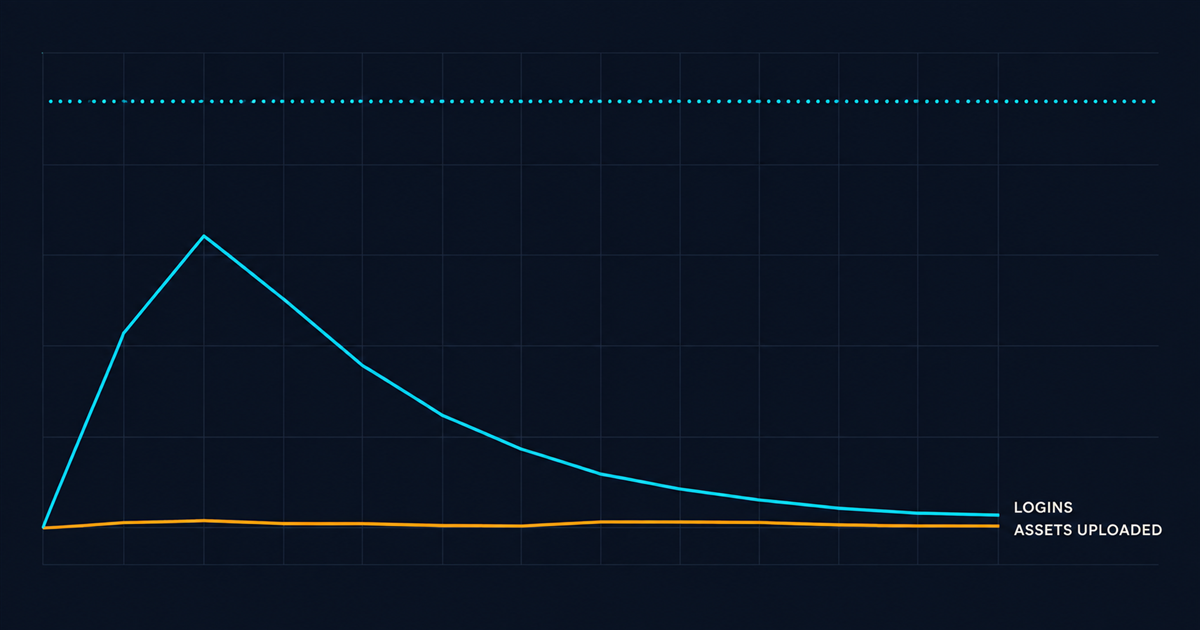
    Every metric that looks like adoption failure follows from this. Login counts stay high because consumers keep coming. Upload counts fall because contributors stop paying. And because consumption looks healthy on the dashboard, the decay is invisible for two quarters.

    An adoption curve chart with a cyan logins line spiking at launch then decaying, and an amber assets-uploaded line that never leaves the floor

    The four failure mechanisms

    1. Contribution is unfunded. Nobody’s objectives include cataloguing. The studio manager is measured on output, the agency is paid for deliverables, the campaign lead is measured on the campaign. Describing assets is the thing everyone does last and therefore does not do.

    2. The system is not where the work is. If contributing requires opening a second application, the fraction of people who do it is much smaller than you would guess. This is not laziness, it is context switching cost, and it is why the embedded picker pattern in integration patterns is an adoption intervention rather than a technical one.

    3. Search does not work well enough, early enough. Consumers give it two or three chances. If the first searches fail because the library is thin or the metadata is sparse, they revert to asking a colleague and never come back. Adoption is won or lost in the first month of consumer experience, which is why launching with a small well-described library beats launching with a large badly-described one.

    4. Nobody owns it. The programme had a project manager. The project ended. The role did not become a job, so schema drift, vocabulary sprawl and permission decay accumulate with nobody watching, and the governance framework becomes a document about a system nobody is running.

    The operating model

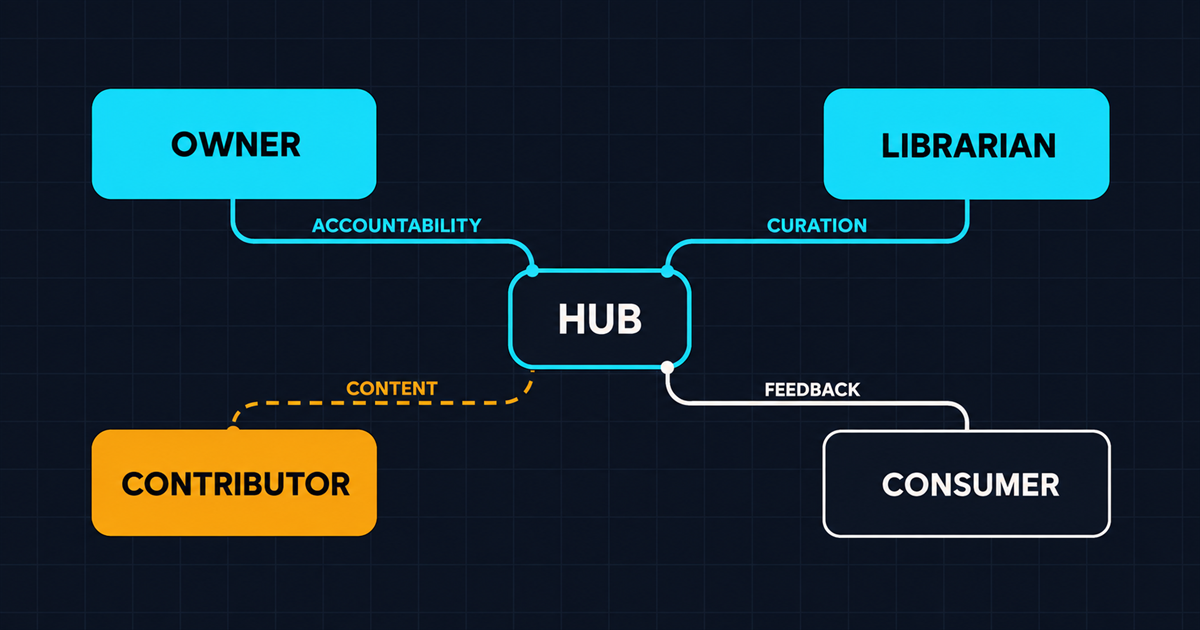
    Four roles. They do not each need a person, but each needs a named owner with allocated time.

    Platform owner. Accountable for the system: roadmap, vendor relationship, integrations, budget. Usually part of a marketing operations or digital function. Roughly 0.3 to 0.5 FTE at mid enterprise scale.

    Librarian. Owns the schema, the vocabularies and data quality. Reviews the metrics, approves vocabulary changes, fixes what is broken. This is the role most often left unfilled and the one whose absence is most visible after eighteen months. Between 0.5 and 1.0 FTE depending on ingest volume.

    Contributors. The studios, agencies and campaign teams who put material in. The critical design question is not who they are but whether contributing is in their brief and their contract.

    Consumers. Everyone else. Need nothing from you except that search works.

    The two that get missed are librarian and the contractual half of contributor. If your agency contracts do not specify that assets are delivered into the DAM with completed metadata, they will be delivered by email in a zip file, and you will pay someone internally to do the cataloguing that the agency was better positioned to do.

    Change your agency statement of work at the next renewal. It is the highest-leverage single intervention available and it costs nothing.

    An operating model figure with owner, librarian, contributor and consumer role cards, the contributor card amber with a broken dashed connector

    Removing the contribution cost

    Since contribution is the bottleneck, most of your effort should go into making it cheaper rather than into persuading people it matters.

    Automate every field you can. Dimensions, format, colour, detected subject, extracted text. None of these should ever be typed. Machine analysis on ingest, such as automatic asset analysis, populates the descriptive layer so humans only supply the business context that machines cannot know. This alone can halve the fields on the form.

    Set defaults from context. If the upload comes from the German product studio integration, market and business unit are known. Do not ask. Server-side upload presets let you bind those rules to the ingest path rather than to the person.

    Cut the form. Six required fields, not twenty. The reasoning is in the metadata schema an enterprise actually needs, and the adoption argument is simply that every field is a cost multiplied by every asset.

    Ingest where the work already happens. Watched folders, direct connectors from the studio’s tools, automated delivery from the agency’s system. The best upload is the one nobody performed.

    Catalogue at the point of highest knowledge. The person who commissioned the shoot knows what it is for. Two months later, nobody does. Capturing metadata from the brief at commissioning time, before the asset exists, is unusual and it works remarkably well.

    How do you tell if adoption is actually failing?

    Not from login counts. Four measures that tell the truth:

    • Contribution rate. New assets per month against your estimate of assets created per month. The gap is your shadow library, and it is the single most important number in the whole programme.
    • Metadata completeness on new assets. Falling completeness means people are gaming the form, which means the form is too long or the fields are unclear.
    • Zero-result search rate. Rising means the library is not keeping up with what people need, which is the consumer-side symptom of a contribution problem.
    • Proportion of published placements referencing the DAM. If your CMS can tell you how many images on the live site come from the DAM versus uploaded locally, that number is the closest thing to ground truth you will get. It is usually sobering.

    Review these monthly for the first year. Not because you will act every month, but because the decay is gradual and only visible as a trend.

    What actually works, in order

    Make the DAM the only path. Not a policy, an architecture. If the CMS can only place images that come from the DAM, the shadow library has nowhere to go. This is uncomfortable and it is the single most effective intervention available. Introduce it after search is good, never before.

    Fund the librarian. A funded 0.6 FTE beats a policy document and an all-hands presentation, every time.

    Launch small and well described. A thousand assets that are findable creates advocates. Fifty thousand that are not creates a reputation that takes two years to shake off. This is also why migration should leave most of the library behind.

    Fix agency and studio contracts. Metadata is a deliverable. Write it in.

    Publish the numbers. Monthly, to the sponsor, including the bad ones. A programme that reports honestly gets support when it needs it. One that reports only launch metrics gets quietly defunded at the next budget round.

    None of this is about training. Training is necessary and it is not the constraint. The constraint is that somebody has to pay the contribution cost, and until you decide who, the answer will be nobody.

    The taxonomy discipline that keeps search working is in designing a taxonomy people actually use, the state model behind it is in the asset lifecycle, the funding argument belongs in the business case, and the foundation is in what enterprise DAM actually is.

  • DAM, PIM, CMS and MDM: who owns which record

    DAM, PIM, CMS and MDM: who owns which record

    The argument always starts the same way. Product marketing wants alt text managed in the PIM because it belongs with the product. The web team wants it in the CMS because it belongs with the page. The DAM team wants it on the asset because it describes the image.

    All three are right, which is why the argument never resolves on its merits.

    Short answer: the question that settles it is not “where does this belong” but “which system is authoritative for this field, and where does everything else get it from”. One system owns each field, everyone else references. Alt text describes the image, so the DAM owns it. The PIM and CMS read it. That rule, applied consistently, resolves nearly every boundary dispute in an afternoon.

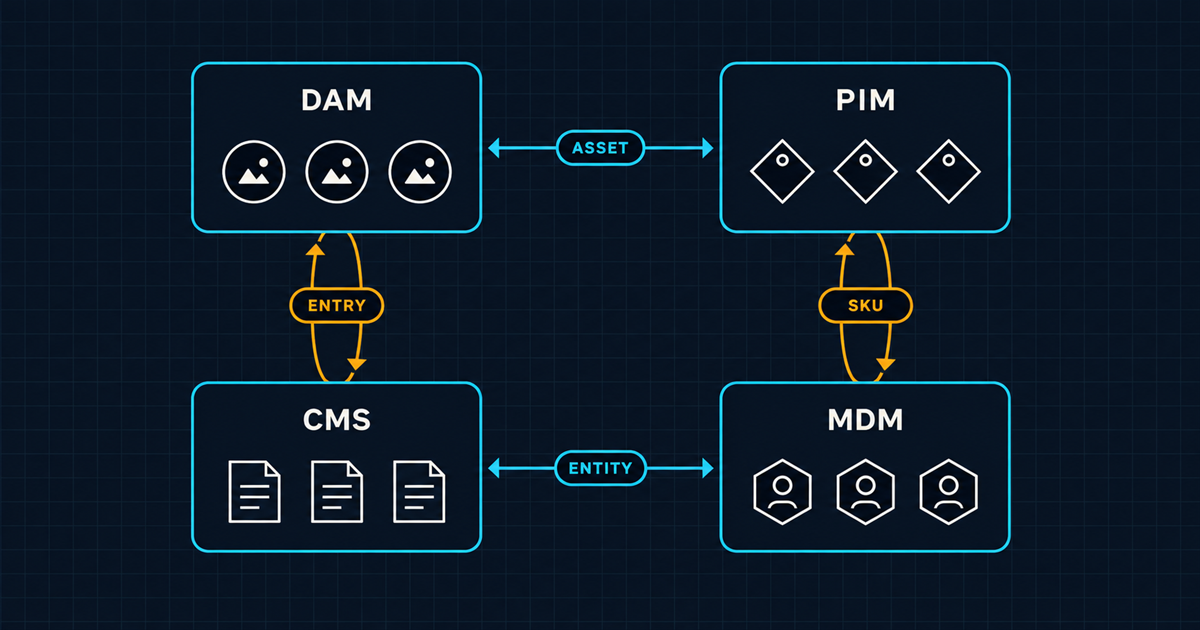
    Four labelled quadrant panels reading DAM, PIM, CMS and MDM connected by cyan token-carrying lines, with two amber connectors doubled back on themselves

    What each system is actually for

    Strip the feature overlap and each one has a distinct job.

    DAM owns the visual and rich media object and everything intrinsic to it. What the asset depicts, who made it, what rights attach, which version is current, how it is allowed to be rendered. The category definition is broader than that in practice, but the intrinsic-to-the-asset test is the useful one.

    PIM owns product information. SKU, specifications, dimensions, materials, pricing structure, category placement, and the localised marketing copy per market. Product information management exists because product data has hundreds of attributes, dozens of locales, and a supply chain of contributors, and no CMS handles that shape well.

    CMS owns page structure and editorial content. Which components sit on which page, in what order, with what copy, in which locale, published when. A content management system is a composition tool, and its record is the page or the component, not the things it references.

    MDM owns golden records for the entities the whole enterprise shares. Customer, product identity, supplier, location. Master data management is upstream of all of the above and mostly invisible to the marketing side, which is why it gets left out of these conversations and then turns out to be the thing defining what a product even is.

    The authority rule

    Write this down and put it in the architecture decision record, because it is the whole framework:

    For every field, exactly one system is authoritative. Every other system that displays it holds a reference, not a copy. If a second system must store the value for performance, it stores it as a cache with a defined refresh, and it is never edited there.

    The failure this prevents is the one that costs the most: two systems that both allow editing of the same field. That produces divergence, and divergence in a field like licence expiry or product dimension is not an inconvenience, it is a defect with legal or commercial consequences.

    The corollary is that “we’ll sync it both ways” is almost always the wrong answer. Bidirectional sync between two systems that both allow edits is a conflict resolution problem, and conflict resolution problems get solved by whoever wrote the integration, at 4am, badly.

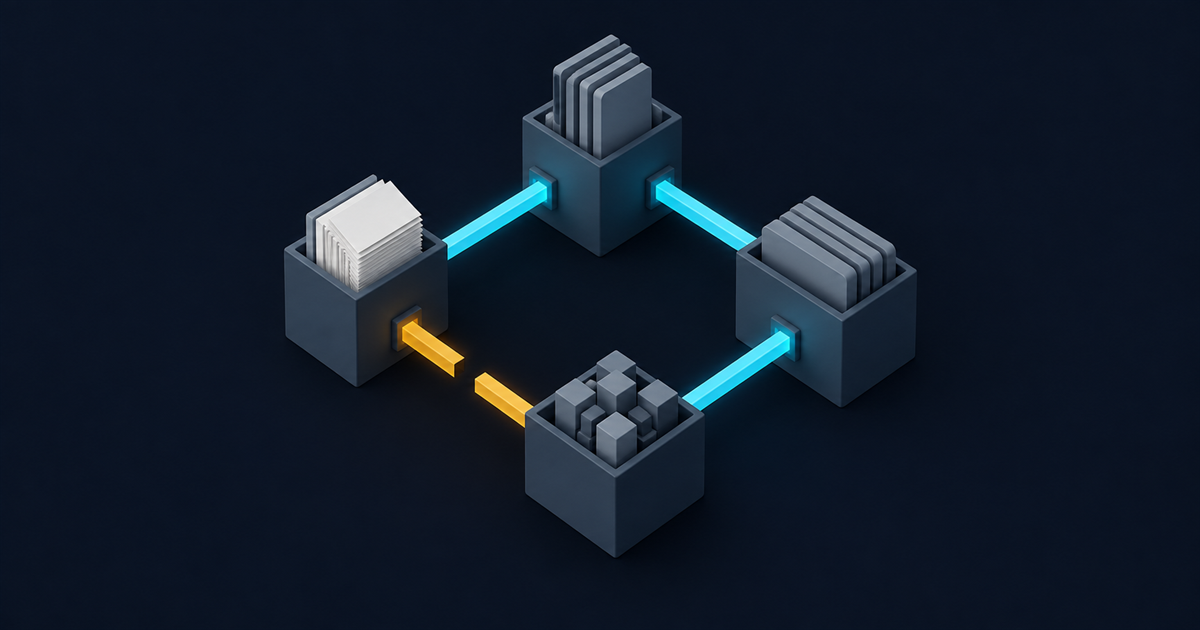
    Four isometric matte filing volumes holding different record shapes, connected in a ring by thin cyan bridges, one bridge amber and broken in the middle

    The boundary map

    Field by field, here is where authority usually lands. This is not universal, but the exceptions should be deliberate and documented.

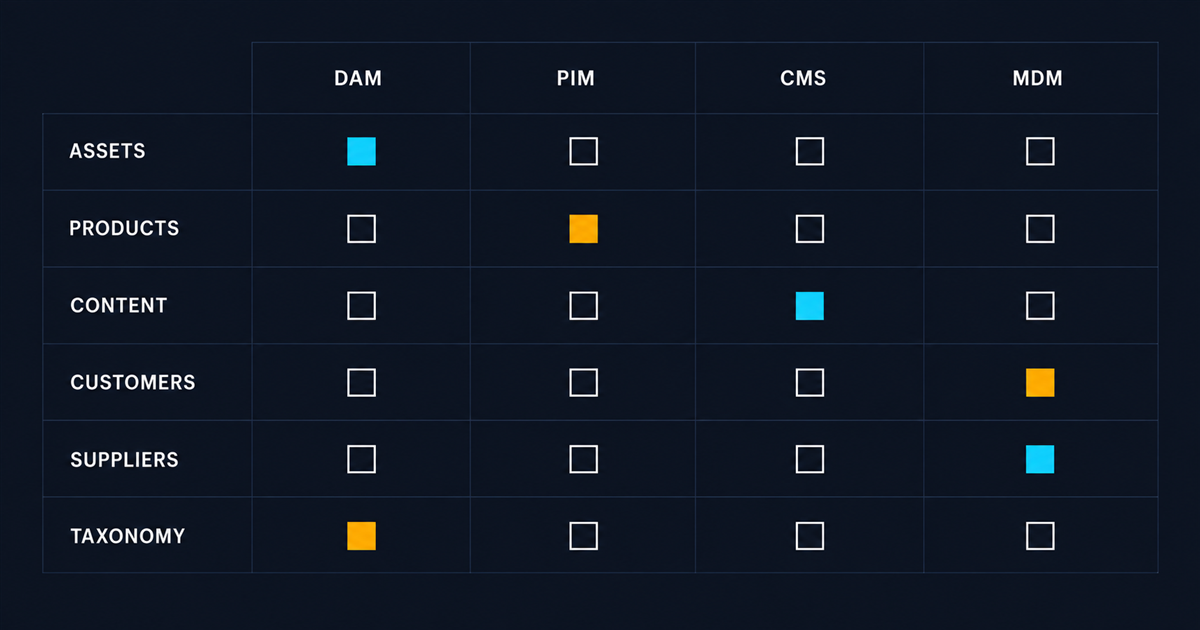
    The DAM owns: the master file and its renditions, what is depicted, photographer and creator, licence terms and expiry, model and property releases, approval state, colour profile, asset-level version history, and alt text.

    The PIM owns: SKU and product identifiers, specifications and attributes, category and taxonomy placement in the commerce sense, per-market product copy, pricing structure, and the association between a product and its assets.

    The CMS owns: page and component structure, editorial copy that is not product copy, navigation, publication scheduling for pages, and the choice of which asset appears in which slot.

    The MDM owns: the canonical identity of products, customers, suppliers and organisational units, and the reconciliation rules between source systems.

    Note where the product-to-asset relationship sits. It belongs in the PIM, not the DAM, because the relationship is a fact about the product rather than about the image. The DAM holds the asset; the PIM holds the statement “these six assets depict this SKU”. Getting this backwards is common and it makes the DAM into a shadow product catalogue.

    The two genuinely contested boundaries

    Most of the map is uncontroversial. Two areas are not, and pretending otherwise wastes a lot of workshop time.

    Alt text and image descriptions. The case for the DAM is that the text describes the image, so it should live with the image and be reusable everywhere the image appears. The case for the CMS is that good alt text is contextual, and the same photograph legitimately needs different alt text on a product page and in a news article. Both are correct.

    The workable answer is two fields, not one argument. The DAM holds a default description of what the image shows, which is intrinsic. The CMS may override it per placement, which is contextual, and the override is the exception rather than the norm. The MDN guidance on the img element and the WCAG overview both support this reading: alt text serves the function of the image in context, and the context is not always known at asset level.

    Crops and renditions. The PIM wants a square product image. The CMS wants a 16:9 hero. Historically both got a stored file, produced by someone, kept somewhere, going stale independently.

    The clean answer removes the argument entirely: neither system stores a crop. Both request one from the DAM by parameter at the point of use. When renditions are derived rather than stored, there is nothing to own, because there is no artefact. Cloudinary’s transformation model is the reference implementation of that pattern, and it turns a governance dispute into a URL. This is the same argument made from the delivery side in single source of truth is an architecture.

    A responsibility matrix grid with six domain rows and four system columns, solid cyan for ownership, hollow for consumption, amber in three contested cells

    Do you need all four?

    No, and most organisations should not buy all four.

    • Under a few hundred products with simple attributes: the CMS can carry product data. Skip the PIM until the attribute count or locale count makes it painful, which is usually somewhere around a thousand SKUs or five markets.
    • Single brand, single market, no external distribution: the CMS media library may genuinely be enough, and adding a DAM adds an integration without adding an answer. The threshold is covered in why the shared drive stops working.
    • MDM is worth its cost when several systems each independently define what a product or customer is. If only one system defines it, that system is your master data management and you do not need a separate one.

    What you should not do is buy a system to solve a problem another system already owns. A DAM bought to fix product data will not fix product data, and a PIM bought to manage images will manage them badly, in a schema designed for attributes.

    How do you decide when two systems both offer a feature?

    Three questions, in order:

    1. Which system holds the record this field describes? Alt text describes an image; the image lives in the DAM. Dimensions describe a product; the product lives in the PIM. This resolves most cases outright.
    2. Which system’s users maintain it? If cataloguers maintain a field and cataloguers work in the DAM, putting the field in the PIM guarantees it stays empty. Authority should follow the workflow where possible.
    3. Which system can enforce it? A field with a controlled list and validation in one system and free text in the other is not a real choice. Enforcement wins, because unenforced fields become inconsistent fields, which is the argument in the metadata schema an enterprise actually needs.

    Write the answers into an ownership matrix and get it signed by the owner of each system. That single artefact prevents more integration rework than any other document in the programme, and it becomes the input to integration patterns for an enterprise DAM.

    If you are still establishing what the DAM half of that map is responsible for, what enterprise DAM actually is covers it.

  • What enterprise digital asset management actually is

    What enterprise digital asset management actually is

    Ask a large organisation where its logo lives and you will get four answers, all sincere, all different. The brand team points at a folder. The web team points at a CMS. The agency points at a link they were sent in 2024. Procurement points at a platform nobody logs into.

    Short answer: enterprise digital asset management is the system of record for your visual material. Not the biggest folder, not the nicest gallery. The one place that can answer what an asset is, what is allowed with it, which version is current, and where it has been used, for everybody, with the same answer every time. Everything else in the category is a feature of that.

    An asset card at centre with five labelled connectors reading identity, rights, versions, usage and renditions, beside a small grey rectangle labelled file with one ragged filename tag

    That framing matters more than it sounds. It moves the conversation off storage, which is cheap and solved, and onto the thing that is actually failing, which is agreement.

    The failure mode nobody puts in the business case

    The stated problem is usually “we can’t find things”. That is a symptom. The condition underneath it is that the organisation has no authoritative answer about its own material, so every team constructs a private one.

    You can see the shape of it in any company past about two hundred people:

    • Duplication as a coping mechanism. People keep local copies because they do not trust the central one to still be there, or to still be right. Every copy is a small fork of the truth.
    • Rights held in someone’s head. A photographer’s licence expired eighteen months ago. The image is on a regional landing page. Nobody in the chain between the contract and the page knows both facts.
    • Version drift across channels. The product shot on the website, in the catalogue, and in the reseller portal are three different crops of two different masters, and none of them is wrong enough to notice.
    • Rework as a line item. A designer recreates something that already exists because finding it would have taken longer than remaking it. This cost is real, recurring, and almost never measured.

    None of those is a storage problem. All of them are a knowledge problem, and knowledge has to be attached to the thing itself or it evaporates.

    What an enterprise asset has to carry

    Use this as the test you hold any platform against, including the one you already own. An asset should know five things about itself, independently of who is holding it:

    • Identity. What it is. Format, dimensions, what is depicted, who made it, which campaign or product or shoot it belongs to, what language it is in.
    • Rights. What is permitted, in which territories, until when. Model releases, photographer licences, music terms, embargo dates. This is the field group with legal exposure attached and it is the one most often left blank.
    • Versions and lineage. Which iteration this is, what it was derived from, what supersedes it. A single product launch generates dozens of near-identical exports and exactly one of them is correct.
    • Usage. Where it has been published, by whom, in what context. Without this you cannot recall an asset, and recall is the whole reason the rights fields exist.
    • Renditions. How it is allowed to appear. Crops, formats, sizes, and the rules that produce them, rather than a folder of pre-baked copies that immediately diverge.

    A system that stores terabytes reliably and describes them poorly is an expensive shelf. The general definition of digital asset management covers ingest, annotation, storage, retrieval and distribution, which is accurate and quietly flattens the two parts that cost money: annotation, which is human time, and distribution, which is machine time.

    An isometric cutaway of a four-tier stack: storage blocks, a metadata lattice, a governance ring, and three delivery surfaces, with only the metadata lattice lit

    What makes it “enterprise” rather than just DAM

    The word is doing real work. Four things change at scale, and each one breaks a tool that was adequate at forty users.

    Multiple owners with legitimate disagreements. Brand, legal, product marketing, regional teams and agencies all have a claim on the same asset and different rules about it. A single flat permission model cannot express that, and a system that forces one will be routed around.

    Federated identity. Nobody is creating accounts by hand. Access has to come from the corporate directory through single sign-on, with groups and roles derived from what HR already knows, or the leaver process silently fails.

    Audit as a standing requirement. Not “can we find out who did this” but “can we produce evidence on request, within a window, without a project”. That is a different engineering problem, and it is covered properly in access control, SSO and audit trails.

    Integration is the deliverable. At enterprise scale the DAM is never the destination. It feeds the commerce platform, the CMS, the print pipeline, the partner portal and half a dozen regional sites. If it cannot do that cleanly it becomes a well-organised dead end, which is why integration architecture deserves more attention in selection than the interface does.

    Is enterprise DAM just a shared drive with better search?

    No, and the difference is structural rather than cosmetic.

    A file server stores bytes under a name. All the meaning lives in the folder path, which means it lives in a convention that one person invented, nobody wrote down, and everyone applies differently. Search over that gives you filename matching, which is why people fall back to asking a colleague.

    A DAM stores an object with fields, and the fields are queryable independently of where the object sits. That is the whole difference: you can ask for approved product photography, cleared for the German market, from the current season, without knowing anybody’s folder convention. The longer version of that argument is in why the shared drive stops working.

    A stacked area chart with a thin cyan governed band under a much larger amber ungoverned band, and a low flat findable line

    Where it sits in the enterprise stack

    DAM is one of four systems that all look like each other from a distance and own genuinely different records. Product data belongs in a PIM. Page structure and copy belong in a CMS. Golden records for customers, products and suppliers belong in master data management. Visual material and its rights belong in the DAM.

    The boundaries blur at the edges and most implementation pain lives exactly there, which is why it gets its own treatment in who owns which record.

    The architectural decision underneath everything

    There are two ways to run this, and the choice determines your cost curve for the next five years.

    Stored variants. Every crop, format and size is a file somebody created and somebody now has to keep. One master becomes fifteen artefacts, all of which diverge the moment the master is re-shot, most of which are never used, all of which are counted in your storage bill and your search results.

    Derived renditions. There is one master and a set of parameters. The 400px thumbnail, the square social crop, the AVIF version: each is produced on request from the original and cached. Platforms built around this model expose it as part of the delivery URL, and the Cloudinary transformation reference is a reasonable place to see what the parameter set looks like in practice.

    The consequence people underestimate is not storage cost. It is that when a rendition is a parameter, adding one costs nothing and retiring one costs nothing. When it is a file, both are projects with a ticket queue.

    When you do not need this

    Be honest about the threshold. You do not need an enterprise DAM if:

    • You have one team, under a few thousand assets, and everyone sits in the same tool already. A well-run folder structure with a naming convention genuinely works at that size.
    • Your material has no rights complexity. If everything is owned outright and used forever, the highest-value field group is empty and you are buying a filing cabinet.
    • You have no second channel. A single website with a single CMS does not need a separate system of record for its own images.

    The moment any two of those stop being true, the cost of not deciding starts compounding. That is usually before anyone notices, which is why the requirements checklist is worth running early rather than after the first rights incident.

    Where to start

    Do not start with a vendor demo. Start with three questions you can answer this week:

    1. How many masters do we have, and how many copies of them? The ratio is your duplication tax. Anything above 3:1 is a governance problem, not a storage one.
    2. Which fields would we have to fill in before search became useful? If the honest answer is fifteen, your schema is wrong before you have bought anything. The shape of a workable one is in the metadata schema an enterprise actually needs.
    3. What happens today when a licence expires? If the answer involves someone remembering, you have found the thing the platform is actually for.

    Answer those and the shortlist writes itself. Skip them and you will run a nine-month selection process and buy the interface you liked most in the demo, which is roughly how the platform comparison ends up looking so different once you weight it by what you actually do.

    Related field note

    Continue with What to log in content supply-chain controls.

    Related field note

    Continue with A production teardown of regional asset access.

    Related field note

    Continue with The maintenance burden behind legal hold for media.